



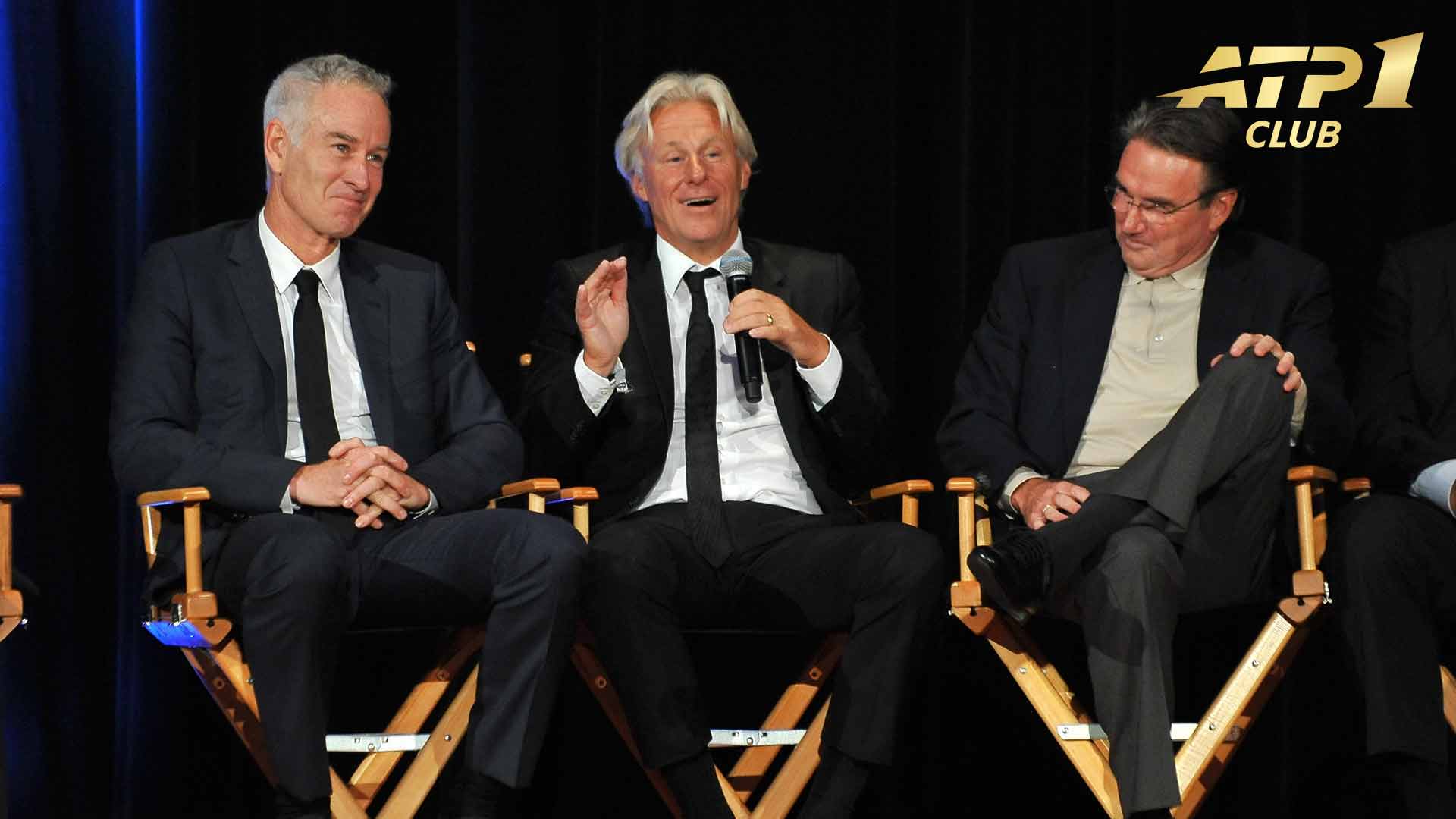
Jimmy Connors, Bjorn Borg and John McEnroe had their similarities and differences both on and off the court. But one thing they shared above all was a special rivalry, with a legacy that has lasted for decades and will remain for many years to come.
Between them, Connors (268), McEnroe (170) and Borg (109) spent 547 weeks atop the PIF ATP Rankings, a total of more than 10 years at the mountaintop of men’s tennis. The early stalwarts of men’s professional tennis did things their own way, but all three found their way to World No. 1 for an extended period of time.
“What separates No. 1 sometimes from No. 100 is so minute that you can’t even see it,” Connors said in Part 3 of ACES: The ATP No. 1 Club docuseries. “So whatever has gotten these 29 guys to No. 1 has that little piece of minute in there that you can’t see.”

Connors, who revolutionised the sport with his two-handed lefty backhand and his all-court game, was the first of the group to climb to World No. 1. The American did so aged 21 in 1974, just one year after the first edition of the rankings was released.
“To relieve that pressure at a young age allowed me to just go cut loose,” Connors said.
The American was known not only for being a relentless competitor, but also for bringing a fiery intensity to the court, bringing the fans and, on many occasions, officials, into the fray. It was that combination of skill and battling spirit that helped him spend 268 weeks as World No. 1 and finish as year-end World No. 1 in five consecutive years from 1974-1978.
If Connors was fire, Borg was ice. The Swede always maintained a calm demeanour and earned the nickname “ice man” for his cool under pressure. That did not take away from his international popularity. In ACES, Boris Becker described Borg as, “a rock-and-roll star disguised as a tennis player”, citing the Swede’s long hair, beard and trademark headband.
Despite first retiring aged 26, Borg produced dominant tennis in his career, spending 109 weeks at World No. 1 and finishing year-end No. 1 twice, in 1979 and 1980, inspiring the future stars of Swedish tennis, including ATP No. 1 Club member Mats Wilander.
“In Sweden, everybody wanted to be Bjorn Borg,” Wilander said. “The lessons in school were literally stopped, and they would roll in the TV. He was The Beatles to us in Sweden. So I started to copy Borg, which is what all Swedes did. And that’s why we have so much success.”
Like Borg picked up from Connors’ reign, McEnroe took the mantle from Borg. McEnroe added another dimension to the generation, with his rebellious yet entertaining personality that made him one of the most compelling figures in sports.
If Connors and Borg — and for that matter, McEnroe and Borg — were fire and ice, Connors and McEnroe were fire meeting fire. Two inimitable lefties with different game styles, but both gritty competitors desperate to win point after point.
“McEnroe, he was me, I was him,” Connors said of his rival. “He’s Irish, I’m Irish. He’s lefty, I’m lefty. Everything that we were kind of clashed.”
The New York-native was different than his rivals in that he served-and–volleyed as well as any player in history and covered the net like a brick wall. The four-time year-end No. 1 had a creative flair with which he flummoxed opponents, chipping away until he found his way to victory.
One thing that all three men had was a great respect for one another. When Borg first spoke about his retirement, McEnroe struggled; the Swede was the man who forced him to dig deeper than he thought possible to raise his level. And although Connors and McEnroe butted heads more often than not, a big reason why was because they knew how big of a threat the other posed at the top of the sport.
That is why five decades later, their legacies are still very much intact.




© Copyright 1994 - 2026 ATP Tour, Inc. All Rights Reserved. No part of this site may be reproduced, stored in a retrieval system or transmitted in any way or by any means (including photocopying, recording or storing it in any medium by electronic means), without the written permission of ATP Tour, Inc.. Terms & Conditions | Privacy | Community Social Media Policy | Modern Slavery Statement | Feedback | Cookies | Your Privacy Choices 

