



The next phase of progress under OneVision, approved by the ATP Board in Turin, will introduce updates across player compensation and support, rankings and the calendar from 2028, while the approval of ATP Ventures will bring the Tour’s media, data and central sponsorship rights together for the first time.
This Q&A explains what is changing from 2028 and what it means for players, tournaments and fans.
The updates at a glance:
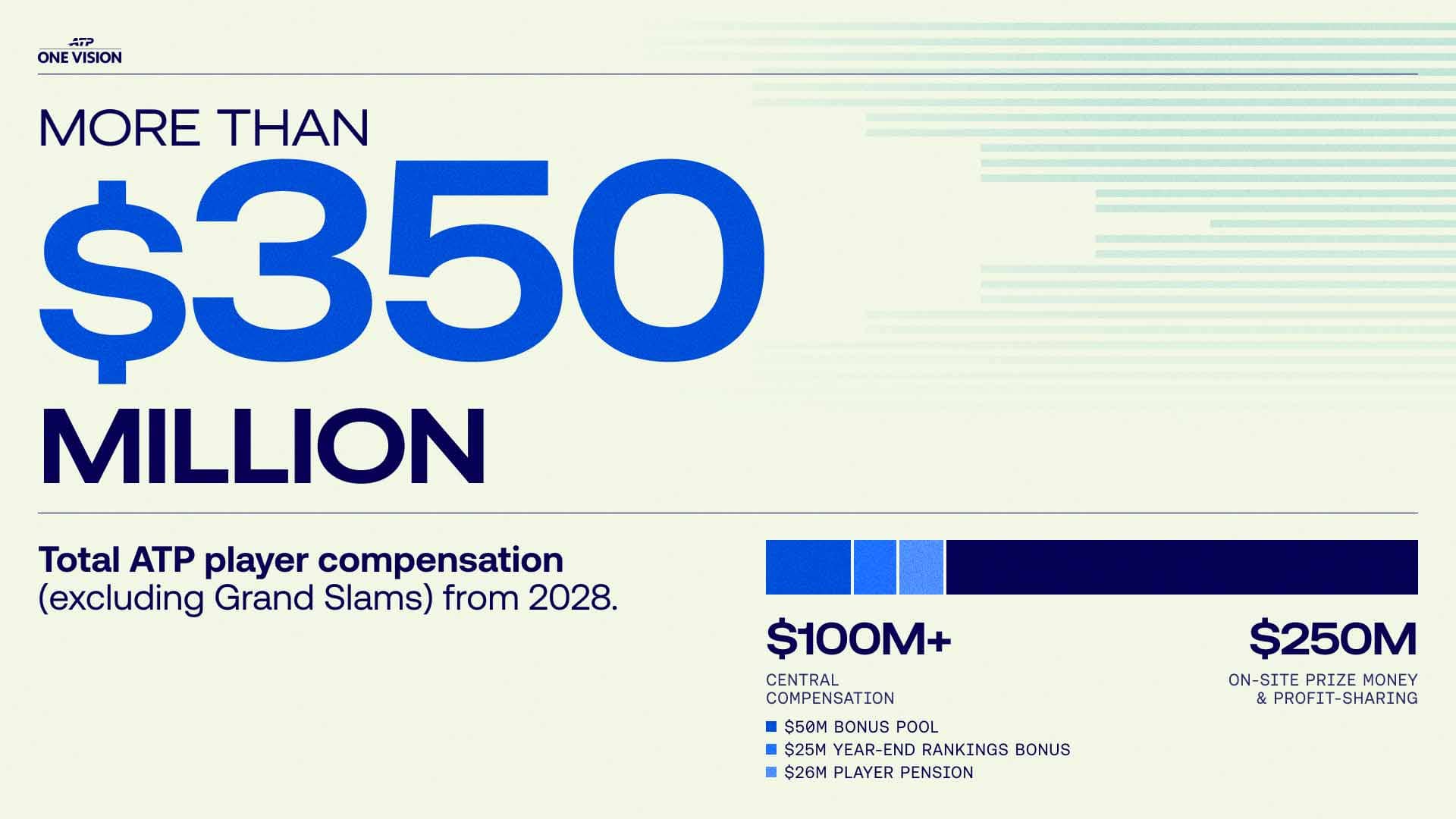
• Over $350 million in ATP player compensation: combining on-site prize money, tournament profit sharing and ATP’s central investment, projected to rise to more than half a billion dollars when Grand Slam prize money is included.
• More than $100 million in central investment: comprising the $50 million ATP Bonus Pool, a $25 million year-end rankings bonus and $26 million for player pensions.
• Higher projected minimum earnings across the Top 250 earners of at least:
• A $50 million ATP Bonus Pool:
• Doubles review: discussions on the doubles proposals will continue, with a decision expected by the end of the year.
• A clearer season structure: changes to rankings and the calendar designed to give players greater clarity around how they plan their seasons and reduce the incentive to overplay.
• ATP Ventures: unanimously approved, bringing ATP Media, Tennis Data Innovations (TDI) and the Tour’s central sponsorship activity together.
Q1: What is ATP trying to achieve through the next phase of OneVision?
Our objective is straightforward: to strengthen competition, better align incentives and extend support to more players, while giving fans more chances to see the world’s best players compete at the moments that matter most.
Three principles sit behind the changes.
First, rewards should follow where fans engage most and, as the sport grows, more players share in that growth. That one idea links the Bonus Pool, the rankings changes, higher minimum earnings and the year-end rankings bonus.
Second, player welfare: the structure should reduce the pressure to overplay and help players manage the demands of the season.
Third, incentive, not obligation: players choose where and when they compete and the structure should make the best choice also the most rewarding one.
Q2: Why does ATP believe further change is needed?
Tennis is in a strong position today. Our events continue to grow, fans are engaging with the sport in more ways than ever and player earnings have reached record levels.
To stay strong, the sport has to keep evolving. Players need a clearer framework for planning their seasons around the biggest events and adjusting their schedules as the season unfolds. Fans want to see the world’s best players compete against each other more often.
We also have a track record to build on. Under OneVision, we introduced 50/50 profit sharing at tournament level as a new source of earnings for players, while pension contributions are at an all-time high. The changes approved in Turin are the next step on a path that is already delivering.
Q3: What has been approved as part of the next phase of OneVision?
Developed with the Player Advisory Council, Tournament Advisory Council and ATP Board, the reforms were approved at the Board’s recent meeting in Turin, which also saw the unanimous approval of ATP Ventures (see Q13). The next phase will take ATP’s central investment into players to more than $100 million from 2028, comprising the $50 million ATP Bonus Pool, a $25 million year-end rankings bonus and $26 million for player pensions.

Together with on-site prize money and tournament profit sharing, this makes up $350+ million in total player compensation across the ATP. When Grand Slam prize money is included, the total is projected to increase to more than half a billion dollars.
The financial package sits alongside changes to the PIF ATP Rankings and points distribution and to the calendar and scheduling. The doubles proposals remain subject to further consultation, with a decision by the end of the year.
Q4: What will the changes mean for minimum earnings?
Through initiatives including the new year-end rankings bonus, a larger ATP Bonus Pool and continued prize money growth, the top earners on Tour are projected to make at least the following from 2028.
| Top Earners | 2025 | 2028 | Increase | Increase % |
| 100 | 793,000 | 1,100,000 | 307,000 | 39% |
| 175 | 306,100 | 450,000 | 144,000 | 47% |
| 250 | 150,000 | 250,000 | 100,000 | 67% |
These figures cover a player’s total earnings across the season, including prize money from the Grand Slams, the ATP Tour and the ATP Challenger Tour. Higher minimum earnings will provide greater financial security across a wider group of players, helping them invest in their careers with more certainty.
Q5: What do the changes mean for fans?
The Tour is built around the world’s best players performing at our biggest events. These are the moments that drive fan interest, grow the sport and enable greater investment in the sport of tennis as a whole.
Tennis has a uniquely complex calendar. The season spans the world and several surfaces and almost all tournaments are direct elimination events. In a standard draw, 75 per cent of players are eliminated within the first two rounds, so even the best players can go out early.
As a result, players experience the calendar very differently. Top players tend to go deep into tournaments, accumulating more matches, ranking points and prize money, while players who lose earlier need more opportunities to compete, earn prize money and improve their ranking. ATP therefore has to build one calendar that works for all players at the same time.
We can never guarantee who will compete at a particular event or who will still be in the draw by the final weekend. What we can do is offer a structure that rewards performance at the Tour’s biggest events, while extending support across the rankings.
The sport’s biggest tournaments are where the strongest competition, ranking points and financial rewards come together. By aligning compensation, rankings and the calendar more closely, we can help players perform at their best on the biggest stages and give fans more chances to see them compete against each other at the moments that matter most.
For fans, that means a season that is easier to follow, more matches between the best players, more rivalries built across the year and higher stakes every week, as each result shapes who arrives at the next big event and how they are rewarded.
Q6: How are the PIF ATP Rankings changing and what does this mean for player workload?
Player welfare is one of the reasons for this reform, not a side effect of it. The demands of the season fall hardest on the players who go deepest at the biggest events. Many players, including those in the mid-rankings, find it hard to protect time for recovery when the system rewards them for adding one more tournament.
Rankings are one of the most important incentive systems in our sport. Results at the Tour’s biggest events will carry greater weight across the season, reducing the incentive for players to overplay after a disappointing result.
Today, players can replace up to three of their weaker ATP Masters 1000 results with better results from ATP 500 or ATP 250 events later in the season. That can create pressure to add tournaments after an early loss to make up the points. This will be removed, so results at mandatory ATP Masters 1000 events count in full and players can plan their schedules around them rather than chasing points and risking overplaying.
More ranking points will also be on offer for players who reach the latter stages of tournaments, such as the semi-finals and final, further rewarding deep runs. A limit on how many ATP 250 results count towards the rankings of top players will help manage workload, while ensuring those results continue to count.
The aim is a season in which the best players arrive at the biggest moments in their best condition. That is better for players, for tournaments and for fans.
Q7: How is the $50 million ATP Bonus Pool changing?
The Bonus Pool rewards players who compete and perform at the Tour’s biggest events. Today, it is shared among the Top 30 performers at ATP Masters 1000 events and the Nitto ATP Finals, with players receiving their full share only if they play all eight mandatory ATP Masters 1000 events. It has helped to strengthen player participation at our biggest events and give fans more chances to see the best players face each other.
From 2028, it will grow from $21.5 million to $50 million, more than doubling the rewards available. This represents almost half of ATP’s central investment of more than $100 million into players.
Payments will go to players ranked in the Top 30 of the PIF ATP Rankings going into each mandatory ATP Masters 1000 event, rather than being based on standings at the end of the season. The highest amounts will go to the highest-ranked players, with the World No. 1 eligible for $2 million per event. A player competing at all eight mandatory ATP Masters 1000 events as World No. 1 could therefore earn up to $16 million from the Bonus Pool alone across the season.
The existing five-event minimum required to receive a share of the Bonus Pool will also be removed entirely, so players earn from the first mandatory ATP Masters 1000 event they play.

Q8: What is the year-end rankings bonus and how will it support players?
ATP will expand its career support through a new $25 million year-end rankings bonus for players finishing the year inside the Top 250 of the PIF ATP Rankings in singles who meet a minimum participation requirement.
The bonus is designed to support player development and reward performance across a broader range of the rankings. While the $50 million ATP Bonus Pool is concentrated on the Top 30, the year-end rankings bonus ensures that as the sport grows, more players beyond the Top 30 share in that growth.
The costs of competing at the highest level are significant and the bonus will help players ranked outside the very top cover them, from travel to coaching and support teams. It will give more players the financial support and certainty to invest in their teams, their preparation and ultimately their careers.
Through ATP’s existing Baseline programme, players will also continue to have access to Income Protection as a financial safety net during injury and other difficult periods. Newcomer Investment will evolve into a new Next Gen payment for young players as they transition onto the ATP Tour. The year-end rankings bonus evolves the existing Minimum Guarantee under Baseline into a larger pool.
Q9: What role will player pensions play?
The ATP Player Pension is a significant and continuing part of ATP’s long-term commitment to players and its growth has been a particular focus under OneVision. ATP expanded the plan from 165 players to 300 each year and the total pension fund is now more than $425 million, supporting more than 1,000 players.
From 2028, $26 million will go to the player pension programme, extending support for players post-career. Pensions also recognise the contribution players make to the Tour over many seasons.
Q10: What is happening with doubles?
Doubles remains a core part of the ATP Tour and the review is focused on finding a model that secures its long-term future. Discussions on the proposals will continue, allowing time for further consultation before a decision is made by the end of the year.
Q11: Why is ATP making changes to the calendar?
We want to create a clearer season structure that helps players plan around the biggest events and adjust their schedules as the season unfolds, while still giving them the freedom to compete across the full breadth of the Tour.
Dedicated tournament category weeks are a key part of this. More weeks will be reserved for a single tournament category, so it is less common for ATP 500 events to be held in the same week as ATP 250 events. This gives players a clearer choice between events of the same level and gives fans a simpler calendar with a clearer narrative across the season.
The previously announced addition of a 10th ATP Masters 1000 event in Saudi Arabia forms part of this effort to strengthen the Tour’s top tier. The 2028 calendar is not yet finalised and is expected to be announced early in the 2027 season.

Q12: Will these changes affect the length of the off-season?
Creating more time for players to rest, rebuild physically and prepare to compete again is an important part of the wider conversation around the calendar.
Players currently have around five to seven weeks between seasons. Our ambition is to create a longer off-season.
Achieving that requires a more aligned calendar across the sport. Bringing tennis together around that ambition will be an important part of the progress we want to make.
Q13: What is ATP Ventures and what will it mean for the Tour?
ATP Ventures was unanimously approved by the ATP Board and the shareholders of ATP Media, marking a landmark moment for men’s professional tennis. For the first time, the media, data and central sponsorship rights held across ATP Media, Tennis Data Innovations (TDI) and the ATP Tour will be brought together under one roof.
ATP Ventures will create a one-stop shop designed to accelerate the commercialisation of the Tour’s rights, in furtherance of ATP’s mission, and to improve the experience for fans and partners across media, data and sponsorship. Work on the long-form agreement will take place during 2027, with ATP Ventures expected to begin operations at the start of 2028.
Bringing ATP Media, TDI and our central sponsorship business together under one aligned commercial strategy gives us a huge opportunity to grow the Tour, tell a stronger story around our players and bring fans closer to the sport.
Q14: How does this build on the first phase of OneVision?
OneVision has delivered greater transparency, record player compensation and a stronger economic model for the Tour. This next phase builds on that progress by raising minimum earnings and expanding career support across the player group, distributing the growth of the Tour more broadly while strengthening financial security at different stages of a player’s career.
The next phase of OneVision strengthens our product, while ATP Ventures will transform how we take it to market. Beyond the Tour, the ambition of OneVision is to ensure tennis wins the competition for the next generation of fans, with its best players meeting at its biggest moments and a sustainable career path for those who follow them.



© Copyright 1994 - 2026 ATP Tour, Inc. All Rights Reserved. No part of this site may be reproduced, stored in a retrieval system or transmitted in any way or by any means (including photocopying, recording or storing it in any medium by electronic means), without the written permission of ATP Tour, Inc.. Terms & Conditions | Privacy | Community Social Media Policy | Modern Slavery Statement | Feedback | Cookies | Your Privacy Choices 

