



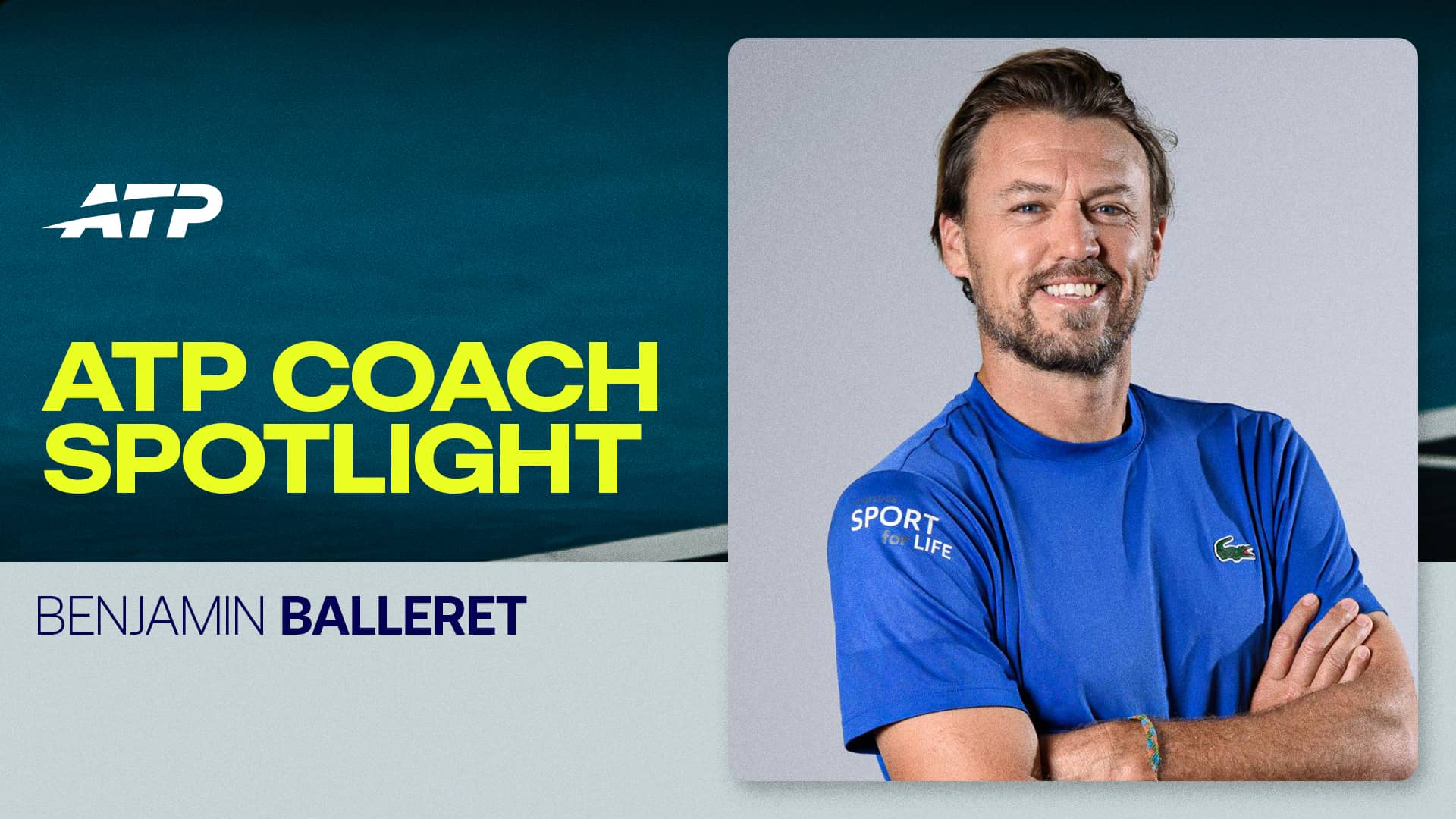
Years ago, Valentin Vacherot would sometimes turn up at ATP Challenger events to simply watch his half-brother Benjamin Balleret compete.
The two Monegasques would hit a few balls together in the evening before Vacherot, still a schoolboy at the time with no real thoughts of turning professional, headed back to his studies. Tennis was something he enjoyed rather than something he chased, but today, the roles have reversed. It is now Balleret watching from the side of the court, guiding the 27-year-old Vacherot as he competes among the ATP Tour’s elite.
“He was just playing tennis for fun,” Balleret told ATPTour.com, reflecting on Vacherot's teenage years. “He was going to school and playing from 5 p.m. to 8 p.m. with his coach. He did this until he was almost 18 years old. I would bring him to some Challengers in Italy to just watch my matches. It wasn’t serious, not really professional.”
What once felt like a casual introduction to life on Tour has evolved into one of the most compelling coach-player partnerships, built not solely on contracts but on family and belief. It is a relationship that made global headlines in Shanghai in October last year, when Vacherot stormed through qualifying to become the lowest-ranked ATP Masters 1000 champion in series history (since 1990).
Ironically, Vacherot began that Shanghai run as the No. 204 player in the PIF ATP Rankings — the exact career-high ranking Balleret reached during his own playing days. Now 43, Balleret admits he never achieved the success he hoped for as a player, but the lessons learned have become central to his effectiveness as a coach.
Before committing full time to Vacherot in 2022, Balleret built a strong coaching resume, guiding Gilles Muller to a career-high World No. 21 and working with Pierre-Hugues Herbert across a four-year spell that included three Grand Slam doubles titles. Those experiences helped shape a philosophy rooted in consistency rather than quick fixes.
“Every player, every human is different,” Balleret said. “Some things for me as a coach are important: work, respect… It doesn't matter who you coach, this has to be there. [You have to] work hard, respect and trust each other. Then everything outside of that, you have to adapt to every player.”

After Vacherot completed four years of college tennis at Texas A&M — where he played alongside his cousin Arthur Rinderknech, whom he later defeated in the Shanghai final — the brothers formally joined forces. What followed were seasons of steady progress, difficult losses and continued emotional investment.
“Sometimes it was difficult because it took time before what happened in Shanghai,” Balleret explained, referring to the sacrifices. “Because he’s my brother, it was even more difficult when you don't have the results you want, when you feel like you're losing so much and you think that you shouldn't lose, some bad losses.
“But we never stopped believing, working and trusting each other — that's more important. Then Shanghai happened… I think everybody talks enough about this, but it was really unreal to go until the end.”
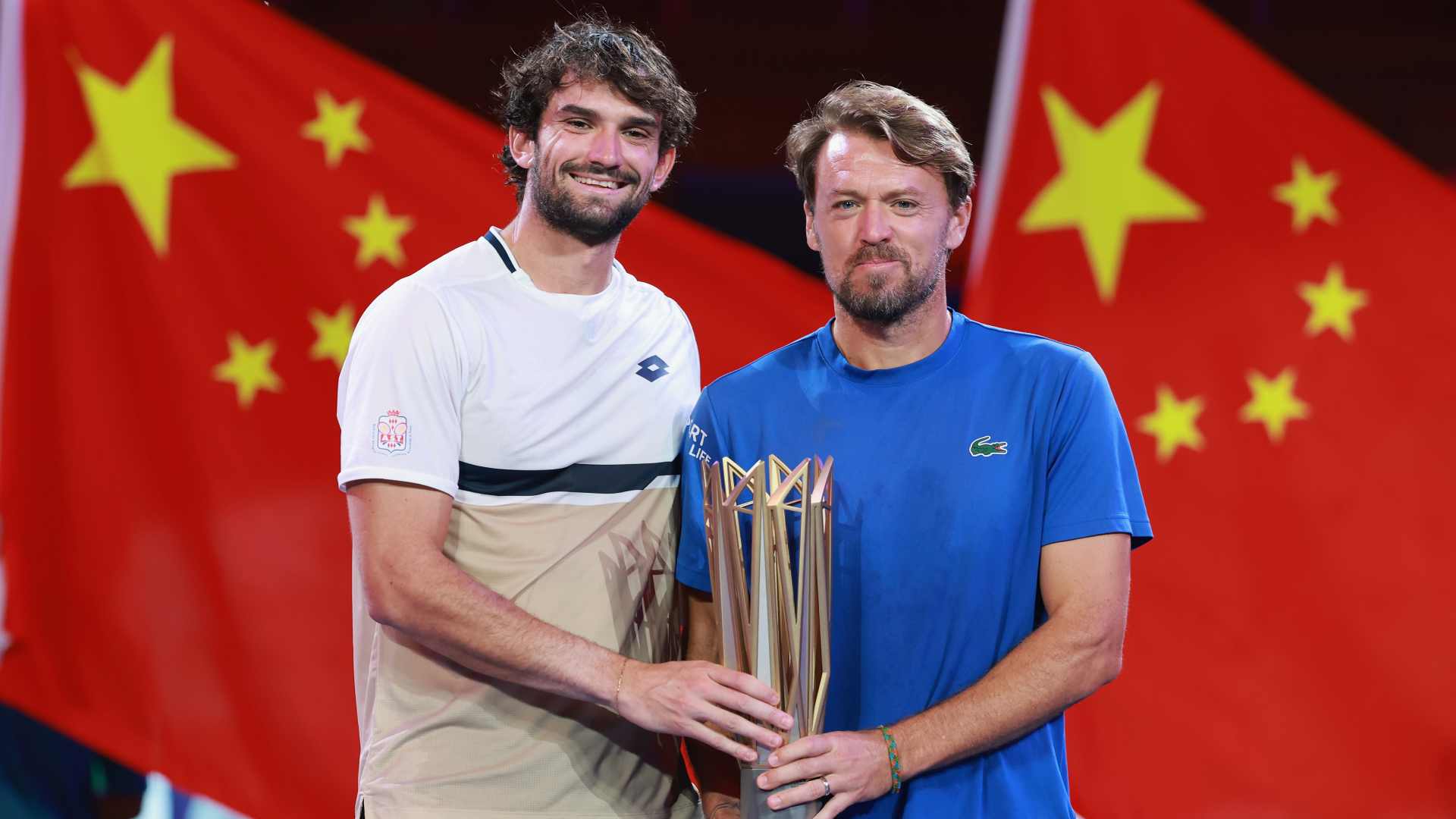 Valentin Vacherot and Benjamin Balleret celebrate in Shanghai. Photo: Lintao Zhang/Getty Images.
Coaching a family member presents its own challenges, particularly when the emotional lines between success and disappointment are thinner. For Balleret, learning when to step back as a brother and when to step in as a coach has been key to sustaining both the relationship and the results.
“I think it's even easier sometimes to tell things to your brother,” Balleret said. “The most challenging part is the emotional part. When we win, I try to not be overwhelmed with the win because it's also my brother and I'm so happy for him. It's the same for a loss. Sometimes it's difficult when you have a bad loss and not to be at the bottom, so I try to be really honest with him.
“I have this thing where I know him very well, better than almost everyone. So this has helped me, of course. But we're also not spending 24 hours together… We try to spend quality time together. It's pretty easy going. For most of the day, I'm his brother and not his coach.”
Shanghai also represented validation for a wider support team that had been carefully assembled over several seasons.
“Val and I, we tried for three years to put together a team that would help him reach his goals,” Balleret said. “That's why he's working with a fitness coach, Julien, his physio, Antoine, the mental coach, Isabelle. Also his girlfriend, Emily… We try to work all together and for all those people also, not only for Val and me.
“I'm so happy that Shanghai happened and that everybody's rewarded with all the work in the dark. We were working in the shadows for so many years. Now Val is more in the spotlight, everybody's more in the spotlight. We're not looking for the spotlight, but you just feel good reaching the goal and being there with the top players and playing every week against those players.”
Vacherot showed the Shanghai title was no one-off. He quickly rose inside the world’s Top 40, reached the quarter-finals in Paris two weeks later and arrived at the 2026 Australian Open — his main-draw debut in Melbourne — as the 30th seed.
So where do they go from here? For Balleret, the focus remains unchanged.
“For this year, the goal for Val is to play the best players and to try to improve every week,” Balleret said. “Maybe he will play this guy and lose to this guy, but what can you improve to beat this guy next? That will be the main challenge this year for Val and I.”
More than 10 years after a young Valentin once watched from the stands without expectation, the tables have fully turned. Balleret is no longer the one being observed. Instead, he is the steady presence behind the scenes, guiding his half-brother through the brightest moments of a career that, not long ago, felt like nothing more than a game.




© Copyright 1994 - 2026 ATP Tour, Inc. All Rights Reserved. No part of this site may be reproduced, stored in a retrieval system or transmitted in any way or by any means (including photocopying, recording or storing it in any medium by electronic means), without the written permission of ATP Tour, Inc.. Terms & Conditions | Privacy | Community Social Media Policy | Modern Slavery Statement | Feedback | Cookies | Your Privacy Choices 

