



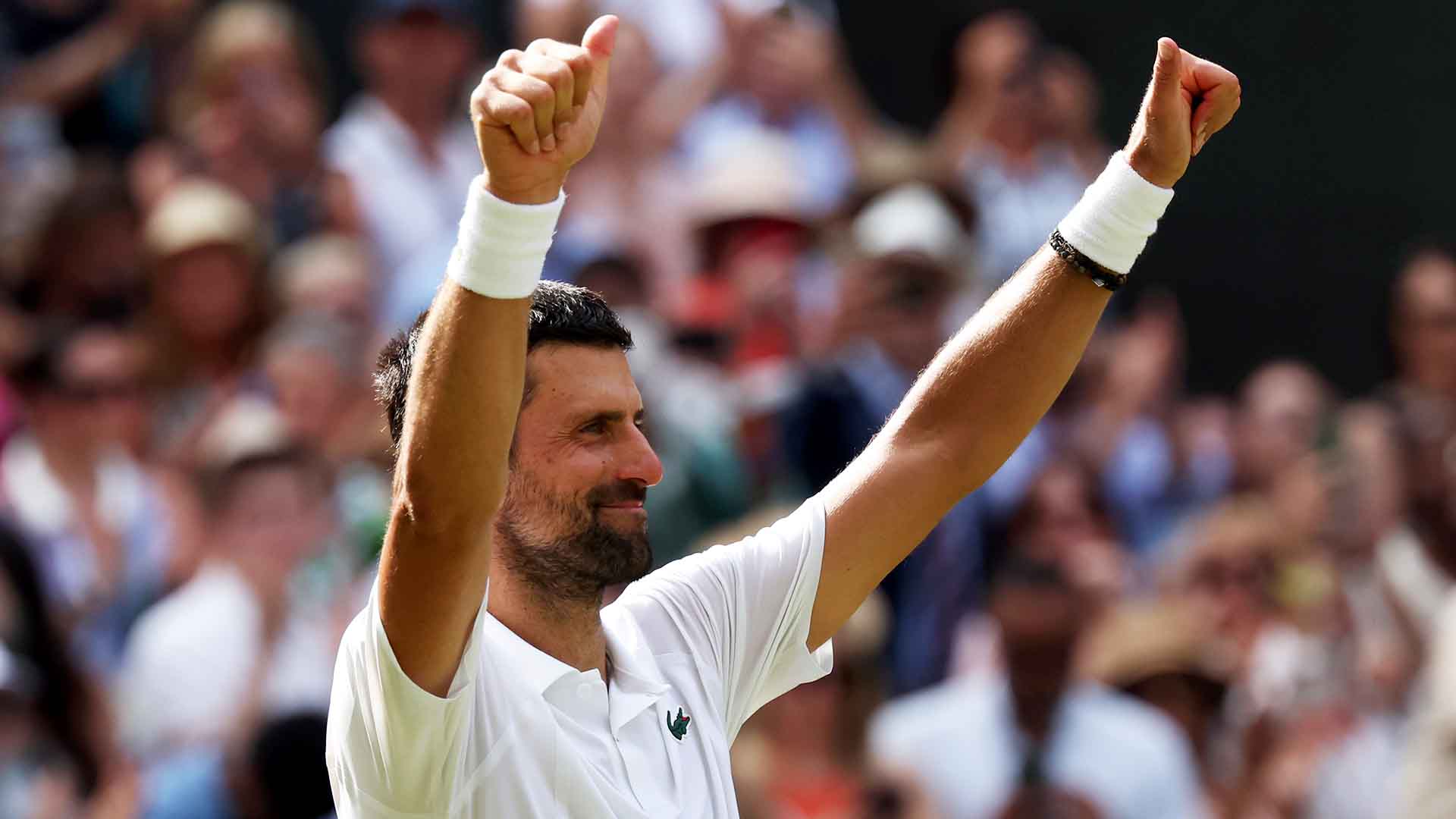
Novak Djokovic was far from satisfied with his performance on Sunday, but the Serbian was happy to take the result and move on after battling past Roman Safiullin to reach the Wimbledon quarter-finals.
The 39-year-old Djokovic admitted he never found his best level during the four-set victory, yet still showed the resilience that has defined his career to earn a record 106th men's singles win at Wimbledon, moving past Roger Federer's all-time mark at the grass-court major.
“To be honest, I [didn’t] feel really great on the court, so I was just relieved to get out of it and get a win,” Djokovic said after his three-hour, 26-minute win. “Satisfaction and enjoyment was not part of today's win, to be honest. Of course, I'm relieved and happy to win it, but I haven't enjoyed it.
“I enjoy the battle. I enjoy the suffering in a sense, to some extent, even though I don't want it, I don't invite it. If it happens, you just have to grind and look for a way to win. That's what I did today again. Against him, another inspired opponent that played really high-level tennis. I'm happy, in that sense, that I managed to find a way to win because that's the end result I'm always looking for.”
Djokovic finished with 37 unforced errors and often struggled to contain Safiullin, who had not won a tour-level match this season before arriving at Wimbledon but produced one of his strongest performances of the year against Djokovic. The qualifier held two set points in the opening set and continued to pressure Djokovic throughout the contest, forcing the seven-time champion to adapt.
Rather than dwelling on the physical demands of another long match, Djokovic felt the bigger issue was the level of his tennis. The former No. 1 player in the PIF ATP Rankings compared it with his second-round win over Stefanos Tsitsipas, in which he produced a slick performance to win in straight sets.
“[Physicality] was okay. Just game-wise, I didn't enjoy my tennis,” Djokovic said. “It's also due to him putting a lot of pressure on me, playing well. I struggled to find the desired level in the game that I'm looking for, which I had in the second round particularly. But a win is a win, even if you win ugly. Hopefully I can build from this.”
After dropping the third set set, Djokovic became increasingly aggressive, looking to shorten points and take time away from Safiullin. The tactical adjustment ultimately helped him wrest back control, adding another example to a long list of matches at Grand Slam tournaments in which he has found solutions despite falling short of his own expectations.
“I've been fortunate to play many matches on the highest stage of Grand Slams,” Djokovic said when asked about his ability to come through tough matches at major tournaments. “There's definitely been more than a few where you go through a difficult match or two at least on your path to win a championship.
“Of course, I'm a perfectionist at core. I always want the best game, the best performance for myself and for others and for the crowd. It's not always possible, and sometimes it's hard for me to accept that and deal with it. It's always like that fresh off the court. I need to just move on and obviously learn and be better next time.”

Although Djokovic has now dropped a set in three of his four matches this fortnight, he has continued to find a way through each challenge while he pursues a record-extending 25th major title.
In the quarter-finals, Djokovic will meet Felix Auger-Aliassime, looking to produce the level he believes is still to come while building on another hard-earned victory at the tournament where he now owns the men's all-time wins record.




© Copyright 1994 - 2026 ATP Tour, Inc. All Rights Reserved. No part of this site may be reproduced, stored in a retrieval system or transmitted in any way or by any means (including photocopying, recording or storing it in any medium by electronic means), without the written permission of ATP Tour, Inc.. Terms & Conditions | Privacy | Community Social Media Policy | Modern Slavery Statement | Feedback | Cookies | Your Privacy Choices 

