



Following the open letter from ATP Chairman Andrea Gaudenzi, ATP answers questions on the proposals and what they mean for players, tournaments and fans.
Q1: What is ATP trying to achieve through these new initiatives?
Our objective is straightforward: to strengthen competition, better align incentives and extend support to more players, while giving fans more chances to see the world’s best players compete at the moments that matter most.
Three principles sit behind these proposals. First, rewards should follow where fans engage most, and as the sport grows, more players share in that growth. That one idea links the Bonus Pool, the rankings changes and Top 250 career support. Second, player welfare: the structure should reduce the pressure to overplay and help players manage the demands of the season. Third, incentive, not obligation: players choose where and when they compete, and the structure should make the best choice also the most rewarding one.
Q2: Why does ATP believe further change is needed?
Tennis is in a strong position today. Our events continue to grow, fans are engaging with the sport in more ways than ever and player earnings have reached record levels.
To stay strong, the sport has to keep evolving. Players need a clearer framework for planning their seasons around the biggest events and adjusting their schedules as the season unfolds. Fans want to see the world’s best players compete against each other more often.
That is why these proposals focus on rewarding performance at our biggest events, supporting the development of more players across the Tour and reducing the pressure on players to overplay.
We also have a track record to build on. Under OneVision, we introduced tournament-level profit-sharing with players, and pension contributions have reached an all-time high. These proposals are the next step on a path that is already delivering.
Q3: What do the proposals include?
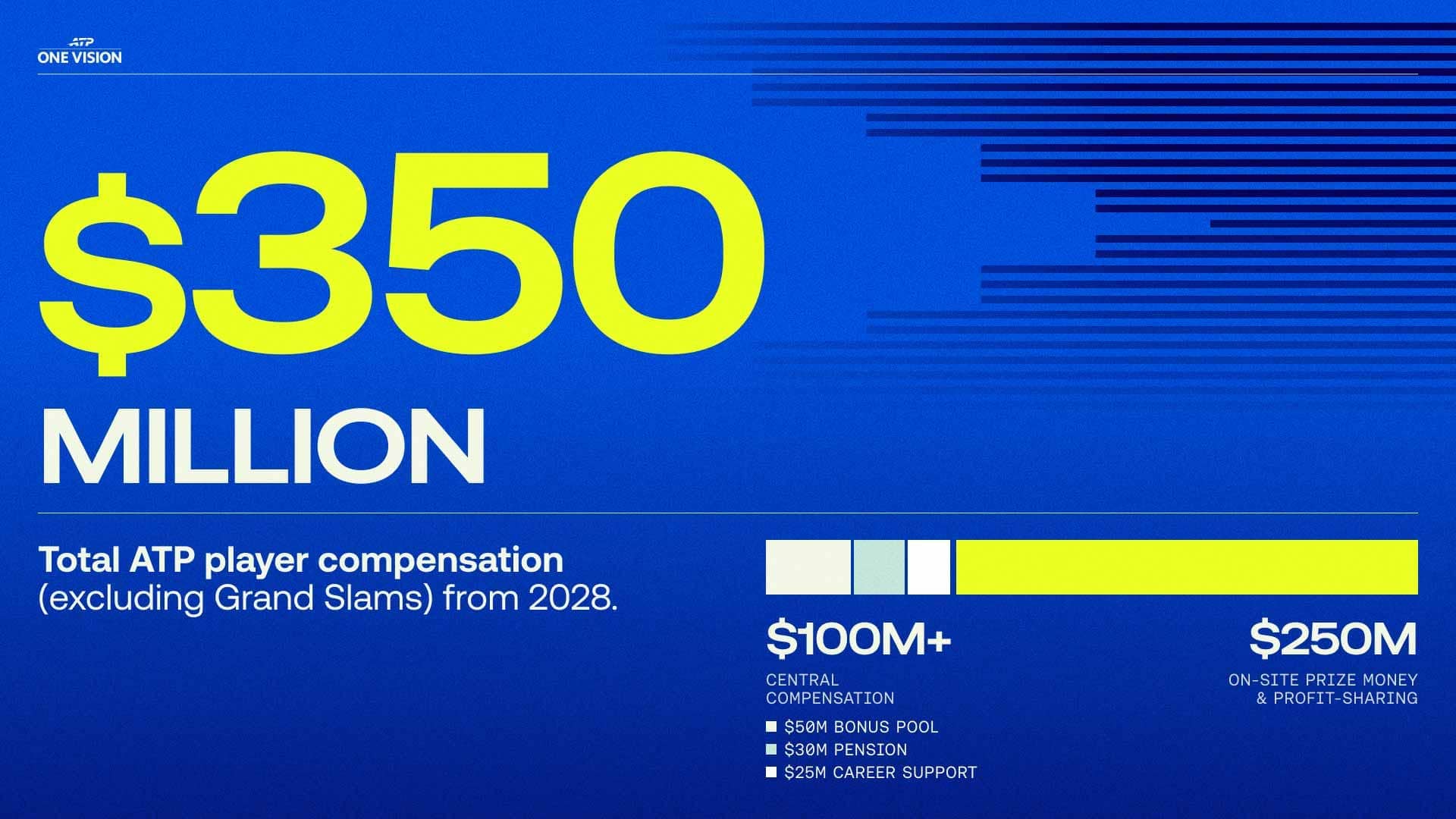
We have worked with players, tournaments and stakeholders across the Tour to define the next phase of progress under OneVision. Subject to further consultation and approval, the proposals would take ATP’s annual central investment in the sport through player compensation and support to more than $100 million from 2028, in addition to on-site prize money and tournament-level profit-sharing.
The proposed package is made up of three central investments: a $50 million ATP Bonus Pool, $25 million in career support for players finishing in the Top 250 of the PIF ATP Rankings, and approximately $30 million in player pension contributions.
Including all central compensation components, on-site prize money and tournament-level profit-sharing, total ATP player compensation (excluding Grand Slams) is estimated to reach $350 million from 2028.
The financial package is one of four connected areas, alongside proposed adjustments to rankings and points distribution, to the calendar and scheduling, and to competition formats. Together, the aim is to give players a clearer framework for planning their seasons, reward performance at the Tour’s biggest events and extend support to more players.
Q4: What do these proposals mean for fans, and how has the calendar shaped them?
The Tour is built around the world’s best players performing at our biggest events. These are the moments that drive fan interest, grow the sport and enable greater investment in the sport of tennis as a whole.
Players choose their own schedules, and the structure should make the best choice also the most rewarding one. The sport’s biggest tournaments are where the strongest competition, ranking points and financial rewards come together. By aligning compensation, rankings and the calendar more closely, we can help players perform at their best on the biggest stages and give fans more chances to see them compete against each other at the moments that matter most.
Tennis has a uniquely complex calendar. The season spans the world and several surfaces. Players are independent athletes who choose where and when they compete, and almost all tournaments are direct elimination events. In a standard draw, 75% of players are eliminated within the first two rounds, so even the best players can go out early.
As a result, players experience the calendar very differently. Top players tend to go deep into tournaments, accumulating more matches, ranking points and prize money, while players who lose earlier need more opportunities to compete, earn prize money and improve their ranking. ATP therefore has to build one calendar that works for all players at the same time.
We can never guarantee who will compete at a particular event or who will still be in the draw by the final weekend. What we can do is offer a compensation, rankings and calendar structure that rewards performance at the Tour’s biggest events.
That is what these proposals are designed to do. They reward top-performing players at the events that generate the most interest in the sport, while extending support across the rankings. The aim is to give fans the best possible competition and keep growing the game.
For fans, that means a season that is easier to follow, more matches between the best players, more rivalries built across the year and higher stakes every week, as each result shapes who arrives at the next big event and how they are rewarded.

Q5: What changes are proposed to rankings and points distribution, and how do they address player workload?
Player welfare is one of the reasons for this reform, not a side effect of it. The demands of the season fall hardest on the players who go deepest at the biggest events. Many players, including those in the mid-rankings, find it hard to protect time for recovery when the system rewards them for adding one more tournament.
Rankings are one of the most important incentive systems in our sport. We are proposing to evolve our rankings system so that results at our biggest events carry greater weight across the season while reducing the incentive for players to overplay after an early exit.
We are also reviewing how ranking points are distributed within tournaments, with more points on offer for players who reach the latter stages, such as the semi-finals and final. This would further reward deep runs at the biggest events.
Today, players can replace up to three of their weaker results from ATP Masters 1000 events with better results from ATP 500 or ATP 250 events later in the season. That can create pressure to add tournaments after an early loss to make up the points. The proposals would remove this, so results at the biggest events count in full and players can plan their schedules around them rather than chasing points and risking overplaying.
Similarly, we are reviewing a limit on how many ATP 250 results count towards the rankings of top players. This is designed to support player welfare and reduce overplaying, while ensuring that ATP 250 results continue to count and players remain free to compete across the full breadth of the Tour.
Together with a clearer calendar that lets players plan recovery around the events that matter most, the aim is a season in which the best players arrive at the biggest moments in their best condition. That is better for players, for tournaments and for fans.
Q6: Why is ATP proposing to increase the Bonus Pool?
The Bonus Pool rewards the players who commit to the Tour’s biggest events. Today, it is shared among the Top 30 performers at ATP Masters 1000 events and the Nitto ATP Finals, with players receiving their full share only if they compete across the eight mandatory Masters 1000s.
It has helped to strengthen players’ commitment to our biggest events and give fans more chances to see the best players compete against each other. We are proposing to build on that by increasing the Bonus Pool from $21.5 million to $50 million, more than doubling the rewards available to players who compete and perform at the highest level.
This reflects the principle that rewards follow where fans engage most. The ATP Masters 1000s and the Nitto ATP Finals are where that engagement is greatest, so that is where the greatest rewards should sit.
This $50 million would represent almost half of ATP’s more than $100 million annual central investment in player compensation and support from 2028.
From 2028, the PIF ATP Rankings would also play a bigger role in how players are rewarded through the Bonus Pool. Under the proposals, Bonus Pool payments would be linked to a player’s ranking at each mandatory Masters 1000, rather than standings at the end of the season. Players would need to compete in a minimum of four mandatory Masters 1000 events to be eligible. At each event, payments would be shared among players in the Top 30 of the PIF ATP Rankings who are in the draw, with the highest amounts going to the highest-ranked.
Every result across the season carries greater significance, because a player’s ranking going into each mandatory Masters 1000 would determine his Bonus Pool payment. For example, the outcome of an ATP 500 final could decide who receives the top Bonus Pool payment at the ATP Masters 1000 event the following week. The whole Tour will benefit with more at stake at our biggest events.
Q7: How will the new player support measures benefit players across the rankings?
The proposals are designed to extend support to more players. A year-end rankings bonus would provide $25 million in career support to players finishing in the Top 250 of the PIF ATP Rankings.
The purpose is to support player development and reward performance across a broader range of the rankings. As the sport grows, more players share in that growth.
Q8: What role do player pension contributions play in these proposals?
The ATP Player Pension is a significant and continuing part of ATP’s long-term commitment to players and its growth has been a particular focus under OneVision. ATP contributed a record $28 million in 2025 and has expanded the plan from 165 players to 300 each year. The total pension fund is now more than $425 million, supporting more than 1,000 players.
The player pension contribution is expected to grow to approximately $30 million in 2028 and continue to grow in the years that follow. Pensions give players financial security beyond their playing careers and recognise the contribution they make to the Tour over many seasons.
Alongside the Bonus Pool and Top 250 career support, the pension forms part of ATP’s more than $100 million annual central investment in player compensation and support from 2028.

Q9: Why is ATP reviewing doubles?
We are reviewing the long-term structure of our competition formats, including potential adjustments to doubles draw sizes and player compensation distribution, with the aim of creating a more sustainable long-term model while maintaining doubles’ important role on the Tour.
Doubles will continue to be a core part of the ATP Tour. The review is focused on identifying a model that gives the discipline a sustainable long-term future, works effectively for tournaments and fans and supports the wider player pathway.
Importantly, any reallocated prize money would remain dedicated to player compensation and is expected to be reinvested into singles qualifying and early rounds. We are discussing the review directly with the Player Advisory Council, so players’ views help shape the final model.
Q10: Why is ATP proposing changes to the calendar and schedule?
We want to create a clearer season structure that helps players plan around the biggest events and adjust their schedules as the season unfolds, while still giving them the freedom to compete across the full breadth of the Tour.
That includes dedicated tournament category weeks and the previously announced addition of a 10th ATP Masters 1000 event in Saudi Arabia, which forms part of the broader effort to strengthen the Tour’s top tier.
Dedicated tournament category weeks would see more weeks of the season reserved for a single tournament category, reducing how often ATP 500 and ATP 250 events run at the same time. For players, this would offer a clearer choice between events of the same level and, for fans, a simpler calendar with a clearer narrative across the season. While this is unlikely to be achieved in full from 2028, we expect to make strong progress towards it.
The goal is a more coherent season for players and fans, with the strongest competition, ranking points and financial rewards coming together at the Tour’s biggest events.
Q11: What do the proposals mean for ATP 500 and ATP 250 tournaments?
A clearer hierarchy strengthens every category, not just the top tier. Every event benefits when fans, broadcasters and partners can follow a season with a clear narrative and the biggest events sit at its peak.
Dedicated category weeks mean ATP 500 and ATP 250 events compete less with each other for the same players, giving tournaments more predictable fields and a clearer place in the season. And because a player’s ranking going into each mandatory Masters 1000 would determine his Bonus Pool payment, results at ATP 500 and ATP 250 events carry greater stakes every week.
Any limit on ATP 250 results would apply only to top players and would be about workload. ATP 250 results would continue to count, and ATP 250 events remain the foundation of the Tour, where players build their careers and future stars emerge. A stronger Tour as a whole grows the commercial value of every event within it.
Q12: Are these proposals final, and how do they fit within OneVision?
No. The proposals remain subject to further consultation and approval. We will continue to develop them with the Player Advisory Council, Tournament Advisory Council and ATP Board, while consulting with our wider membership. The goal is to bring a final package forward for consideration at our year-end meetings in Turin.
These proposals represent the next phase of progress under OneVision as ATP continues to strengthen the Tour and the sport of tennis. Our immediate focus is the ATP Tour, but the ambition reaches further: ensuring tennis wins the competition for the next generation of fans, with its best players meeting at its biggest moments and a sustainable career path for those who follow them.




© Copyright 1994 - 2026 ATP Tour, Inc. All Rights Reserved. No part of this site may be reproduced, stored in a retrieval system or transmitted in any way or by any means (including photocopying, recording or storing it in any medium by electronic means), without the written permission of ATP Tour, Inc.. Terms & Conditions | Privacy | Community Social Media Policy | Modern Slavery Statement | Feedback | Cookies | Your Privacy Choices 

