



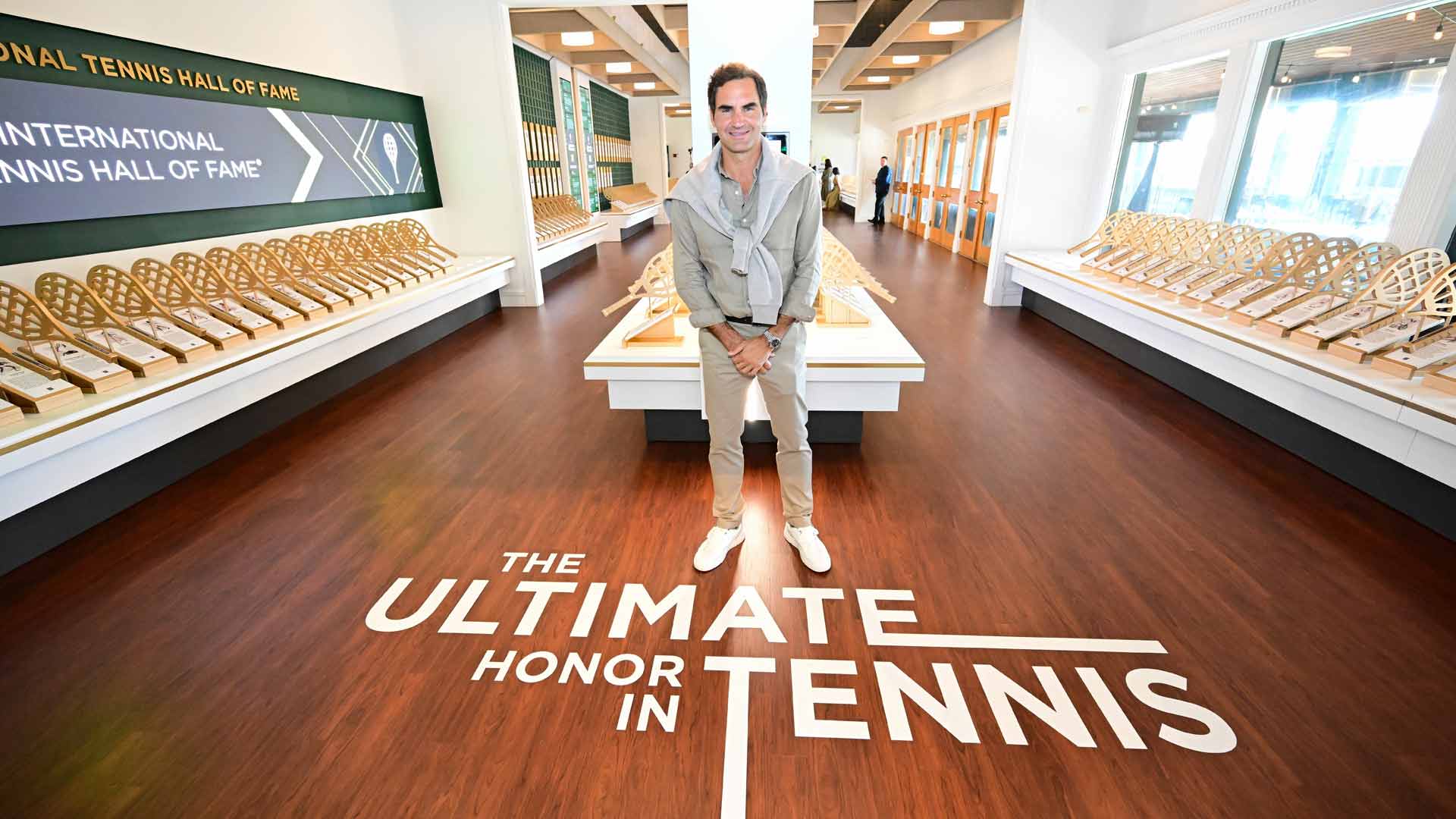
On Saturday evening, Roger Federer will be inducted into the International Tennis Hall of Fame in Newport, Rhode Island. Just more than five years on from the final singles match of his illustrious career, the 45-year-old will take his rightful place next to the best players in the history of the sport.
The Swiss legend won 103 tour-level titles, 20 major trophies and 1,251 tour-level matches. He spent 310 weeks as the No. 1 player in the PIF ATP Rankings, including a record 237 consecutive weeks atop the sport.
The achievements are endless, really: 10 consecutive major finals from 2005 Wimbledon through the 2007 US Open, 23 straight Slam semi-finals from 2004 Wimbledon through the 2010 Australian Open and 36 major quarter-finals in a row, too. There were six Nitto ATP Finals crowns, 28 ATP Masters 1000 triumphs, a 24-final winning streak and five ATP Year-End No. 1 presented by PIF honours.
But stats will never define Roger Federer. The Basel-born star has meant so much more to tennis and the entire sporting world.
When Federer played his first ATP Tour match in Gstaad in July 1998 as a 17-year-old, it was impossible to predict the way he would revolutionise our sport. In 24 years as a professional, a boy from Switzerland with a dream became a magic-making machine who attracted millions of fans across the globe.
There was the lethal forehand, the underrated one-handed backhand, silky-smooth net play, deft touch and one of the best serves in the history of the sport. The tweeners and late-career SABR (Sneak Attack By Roger) stunners were jaw dropping, too. Despite not playing much these days, Federer took to a grass court in Newport Friday and, during an exchange with fellow ATP No. 1 Club member John McEnroe, hit a behind-the-back volley winner. Because of course he did, and did so with a big smile.
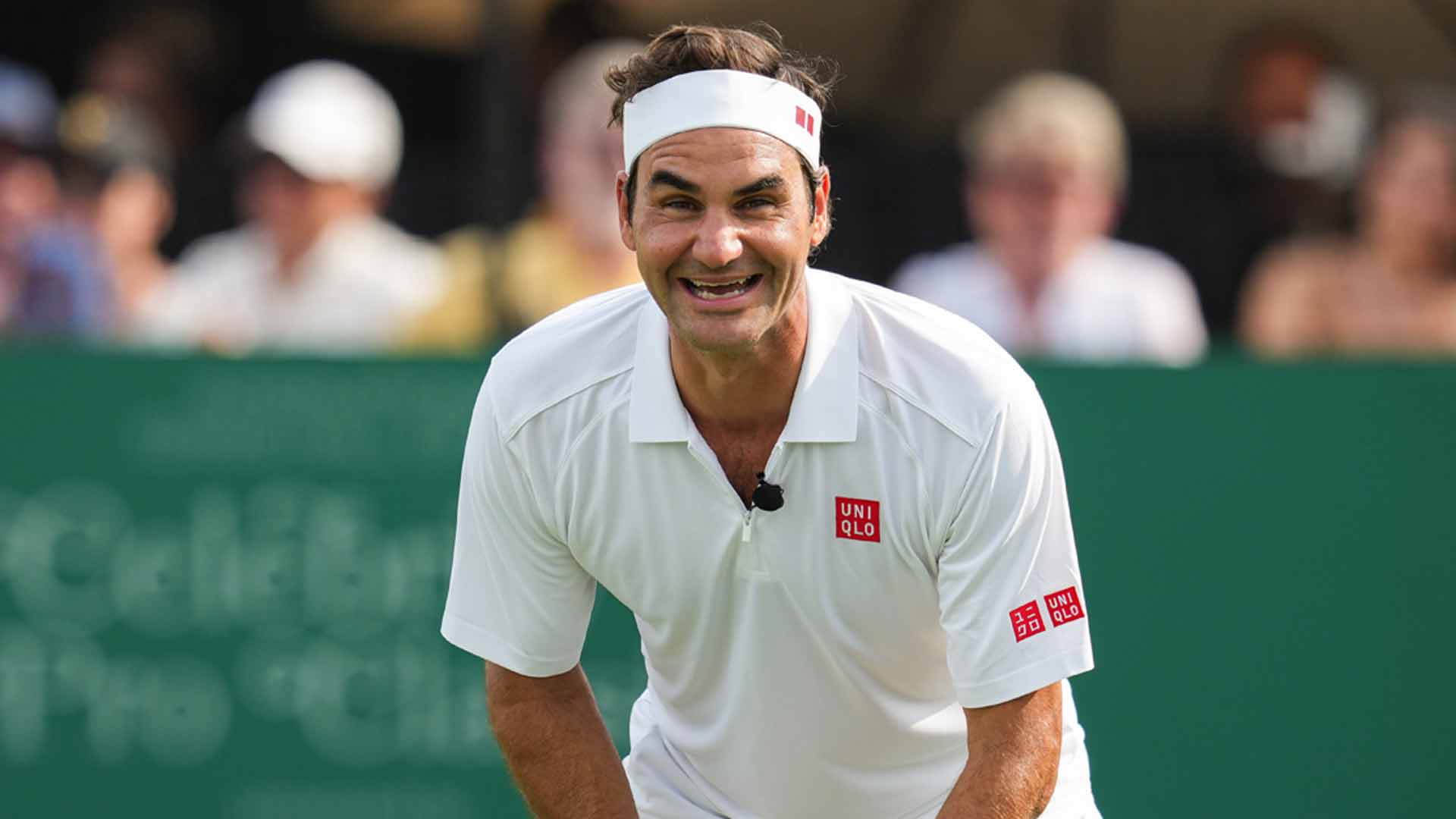
Photo: Joe Faraoni/International Tennis Hall of Fame
People have always simply wanted to be there to watch Federer hit tennis balls. Most fans of a player watch their favourite in the hopes they will win. But Roger — yes, he is one of the people around the world instantly known by his first name — was different.
As David Foster Wallace once wrote, there were “Federer Moments”. You simply had to be in the stands or glued to the television to witness them.
Federer is a man of calm, cool style: Consider him tennis’ James Bond. But put him in a competitive environment, and boy did he want to win. The countless championship-point celebrations — giant leaps, beaming smiles and arms in the air among them — illustrated that over and over again.
Roger has always had a way with words, too. Perhaps the moment that provided the most insight into the man and the athlete came in 2024, when he delivered the commencement address at Dartmouth College (fittingly becoming Doctor Roger, too).
“Retired. The word is awful,” Federer said. “I finished one big thing and I’m moving on to the next. Like you, I’m figuring out what that is.”
What would the tennis world do without Roger? The truth is, Federer has not gone anywhere. The excitement upon his return to the scene when he does make appearances remains the same as it does during his playing days. The former World No. 1’s aura remains unmatched. People love even the mention of his name,.
But perhaps the most common misconception about Roger Federer is that he is very much human. Yes, one of the best players in tennis history produced moments of magic that appeared impossible. But Federer, who still is the centre of attention in every room he steps into, is very much one of us.
“Effortless is a myth. I mean it. I say that as someone who has heard that word a lot,” Federer said during his Dartmouth speech. “People would say my play was effortless. Most of the time, they meant it as a compliment. But it used to frustrate me when they would say, ‘He barely broke a sweat’ or, ‘Is he even trying?’ The truth is I had to work very hard to make it look easy.”
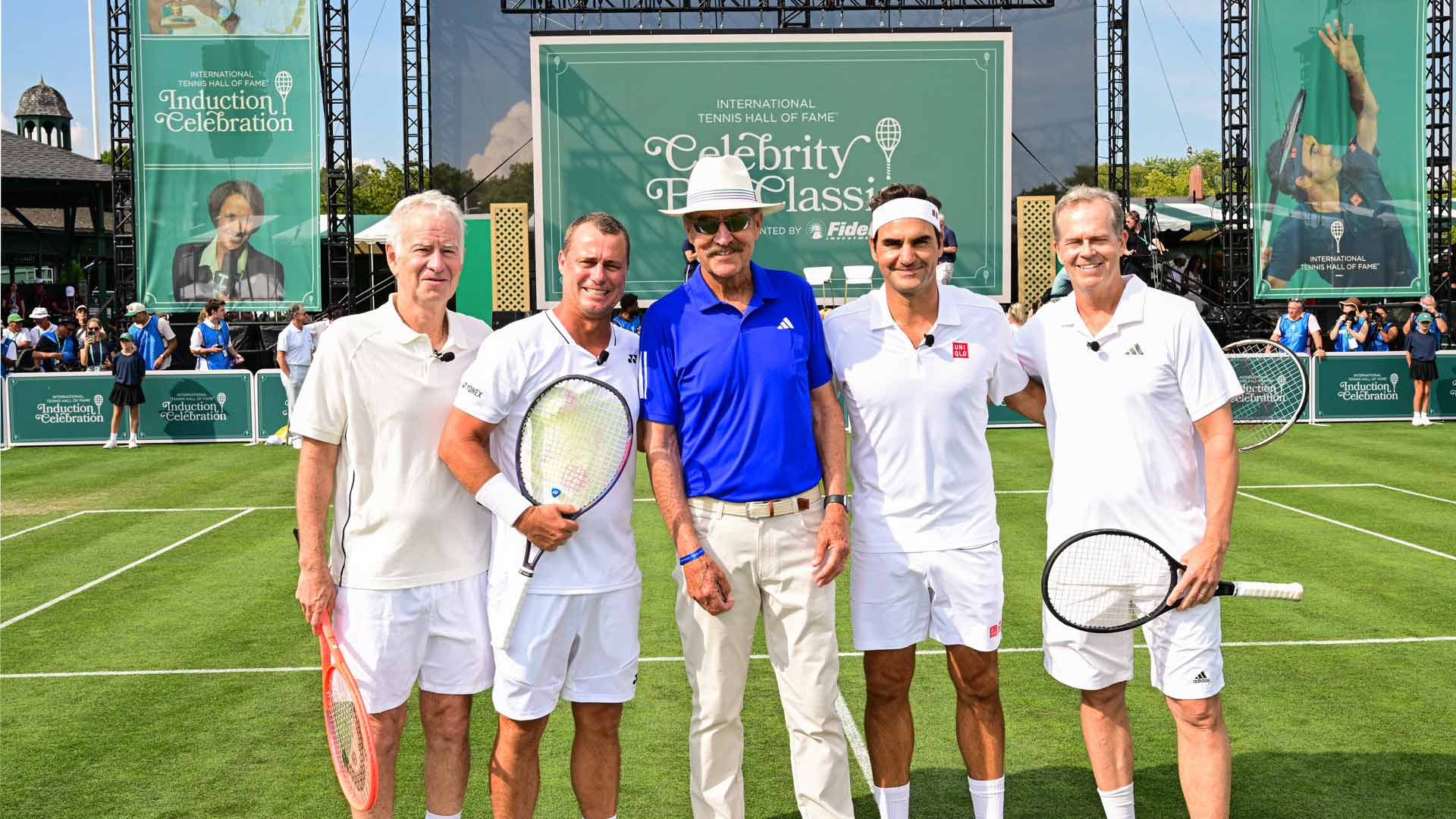
John McEnroe, Lleyton Hewitt, Stan Smith, Roger Federer and Stefan Edberg. Photo: Ben Solomon/International Tennis Hall of Fame
Federer actually had losing Lexus ATP Head2Head records against his two greatest rivals: Rafael Nadal (16-24) and Novak Djokovic (23-27). There was the legendary 2008 Wimbledon final, in which Nadal found a way past his rival as darkness descended on Centre Court. From match point down to Federer in the 2011 US Open semi-finals, Djokovic changed the course of history with an unforgettable stretch forehand return, and then he did so again in the 2019 Wimbledon final, in which Federer won 14 more total points.
As Roger would say himself, there is no such thing as perfect. Everybody wins, and everybody loses. That is normal and part of life. Roger never shied away from that. In fact, he embraced it.
That is why it was so common to see him cry. There was never a doubt how much the Swiss cared about his craft, and all it took was looking at his eyes. In good moments and bad, Federer often shed tears, proof of the passion he brought to the court every time he stepped on one.
So even though Federer repeatedly redefined what was possible in our sport — from his unfathomable 237-week streak at No. 1 and passing Pete Sampras’ then-record 14 major titles to hitting shots that today some would accuse of being AI-generated — the Swiss brought so much more to the tennis world.
“There was a lot of talk also about maybe my personality and what I brought to the game overall when I wasn't on court, which I was a little surprised. I thought it was about in the moment, forehands and backhands and saving break points and victories and all that stuff,” Federer said earlier this week at Flushing Meadows.
“But actually, it becomes a little bit, not irrelevant eventually, but it's about what were you remembered for, how did you behave in the locker rooms or in the corridors or maybe with the media, or with the tournament directors, the ball kids. I don't know.
“For me, if I look back, that's kind of what I'm very happy about: that I went through 25 years on Tour, and actually felt like I made a lot of friends and a lot of people miss me.”
That is why Roger Federer is an unquestionable fit for the International Tennis Hall of Fame.



© Copyright 1994 - 2026 ATP Tour, Inc. All Rights Reserved. No part of this site may be reproduced, stored in a retrieval system or transmitted in any way or by any means (including photocopying, recording or storing it in any medium by electronic means), without the written permission of ATP Tour, Inc.. Terms & Conditions | Privacy | Community Social Media Policy | Modern Slavery Statement | Feedback | Cookies | Your Privacy Choices 

