



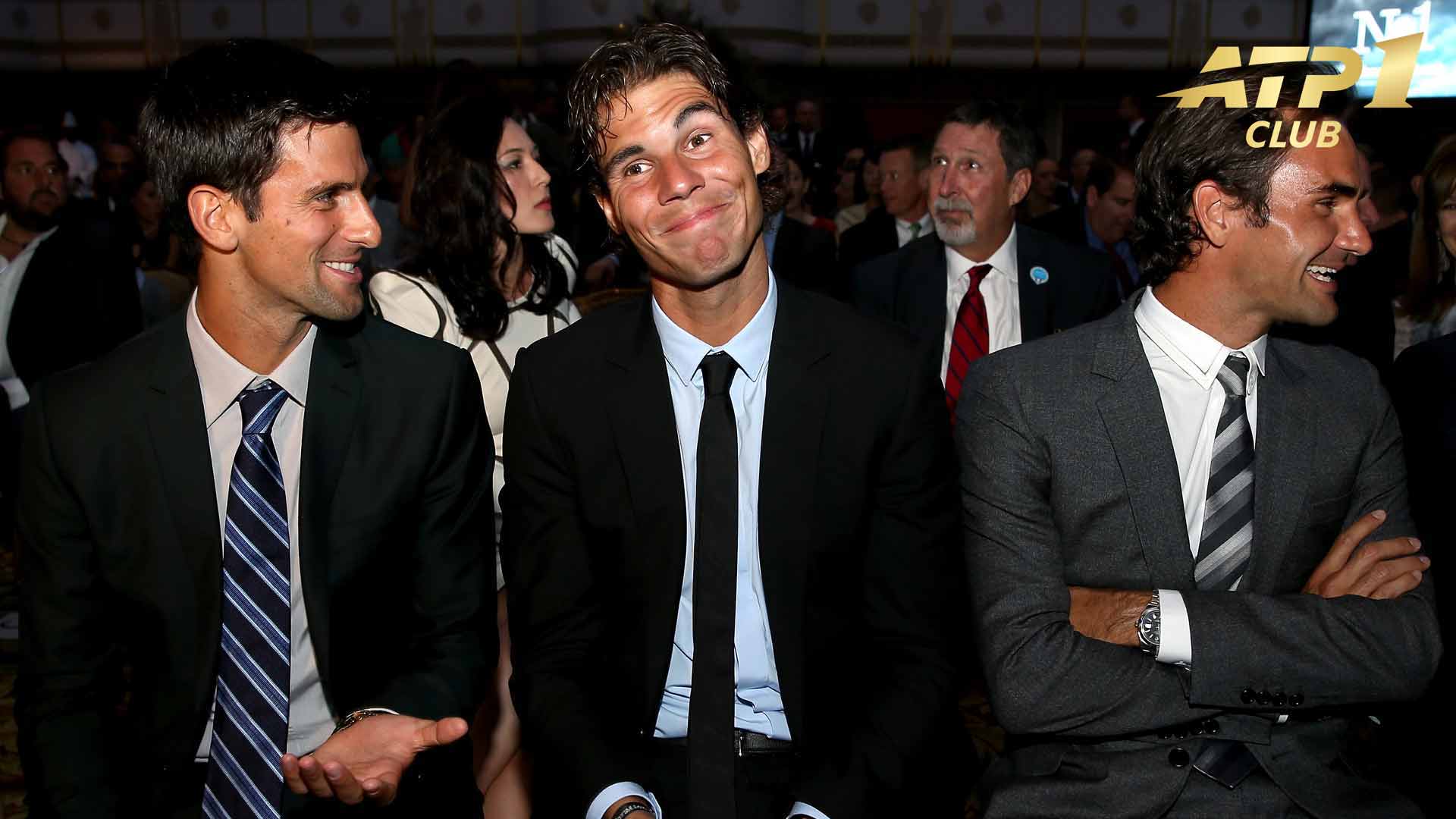
Roger Federer, Rafael Nadal and Novak Djokovic changed our sport, playing some of the most dramatic and high-quality matches in tennis history. The legacies of the Big Three will be forever intertwined, with each man pushing the others to lift their games to new heights as they chased history and one another during a singular era in men's professional tennis.
All longstanding members of the ATP No. 1 Club, the trio has spent a combined 947 weeks atop the PIF ATP Rankings. Djokovic owned the top spot for 428 weeks, Federer for 310 weeks and Nadal for 209 weeks. From early 2004 to late 2016, no one could break the trio's monopoly on the No. 1 ranking.
Federer was the first to rise to the summit, debuting at No. 1 after winning the 2004 Australian Open. He would remain No. 1 for a record 237 consecutive weeks.
"When I was No. 1 in the world for the first time in 2004, I didn't want to have a rival," Federer said in Part 4 of ACES: The ATP No. 1 Club docuseries. "I just wanted to be the best, and then there was the rest, basically."
Nadal soon emerged as a legitimate threat to the Swiss' throne. Early during Federer's reign, the then-17-year-old Spaniard beat the World No. 1 in their first Lexus ATP Head2Head match in Miami. The following season, he beat Federer in the Roland Garros semi-finals, denying the Swiss the Career Grand Slam.
"When Rafa came onto the scene, I guess I first had to appreciate the rival, that he is going to be around," Federer reflected. "He's going to win more in the future and he's going to be around. Maybe I have to adjust my game towards him, so you have to accept that."
Even though he picked up his fair share of wins against Federer in those early years, Nadal still believed Federer was the better player: "When I came into the Tour, Roger was clear, by far the best player in the world," he said.
The Spaniard viewed Federer as the standard he needed to reach and surpass, and his rival's domination was a constant motivation on the practice court and in the gym. All that hard work paid off in 2008 when Nadal rose to No. 1 for the first time after an extended stretch at No. 2.
"He was a workman's workman," fellow ATP No. 1 Club member Jimmy Connors said of Nadal. "You knew that he wasn't going to let one ball past, whether it was the first ball or the last. Winning or getting his butt kicked, no matter what, he was going to play that kind of tennis... Watching him do that was fun."
Nadal finished with a 24-16 advantage in an epic Lexus ATP Head2Head rivalry that also blossomed into a deep friendship, with Nadal famously by Federer's side during his retirement celebration at the 2022 Laver Cup.
"It was special. I think it took rivalries to another level," said Andre Agassi, another ATP No. 1 Club member and the Laver Cup Team World captain. "When I look at these two guys, they did it with class, they did it with respect. They did it for the game."
For all the greatness of Federer and Nadal, Djokovic found a way to make room for a third all-time great in the same era. The Serbian opened the 2011 season with a 41-match winning streak that paved the way for his own debut atop the PIF ATP Rankings in July of that year.
Going from challenger to champion, Djokovic had a winning Lexus ATP Head2Head record against both Nadal (31-29) and Federer (27-23). He surpassed their historic marks to set new records for most total weeks at No. 1, with 428, and total year-end No. 1 finishes, with eight. The Serbian also leapfrogged his rivals on the all-time Grand Slam singles title leaderboard, owning 24 to Nadal's 22 and Federer's 20, while topping the ATP Masters 1000 trophy count with 40 to his rivals' 36 and 28, respectively.
"When Novak had to come on Tour, people called it arrogance. He called it being confident in himself," offered ATP No. 1 Club member Daniil Medvedev. "He always said he wants to be the best player in the history of tennis. And at the end of the story, he managed to do it. He managed to do everything that he said."
When all is said and done, the Big Three era will go down as one of the most dominant periods by any group in any sport.





© Copyright 1994 - 2026 ATP Tour, Inc. All Rights Reserved. No part of this site may be reproduced, stored in a retrieval system or transmitted in any way or by any means (including photocopying, recording or storing it in any medium by electronic means), without the written permission of ATP Tour, Inc.. Terms & Conditions | Privacy | Community Social Media Policy | Modern Slavery Statement | Feedback | Cookies | Your Privacy Choices 

