



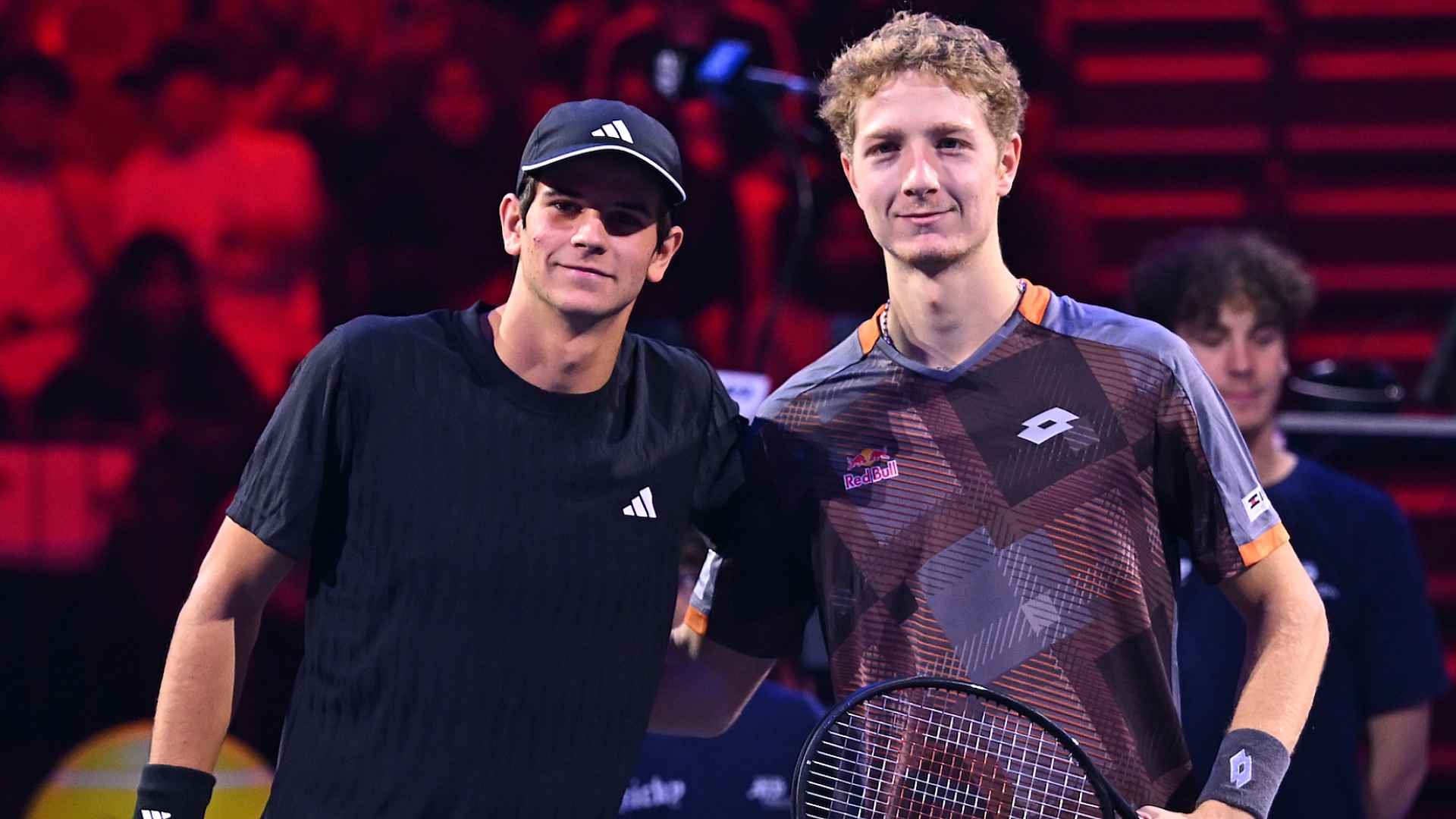
Spain has built much of its tennis identity at Roland Garros. The names come easily: champions, finalists, epic battles, entire generations who have made the clay of Paris a home away from home. But the tournament can also offer a glimpse into the future.
In 2026, the presence of Rafael Jodar, Martin Landaluce and Daniel Merida gives us a valuable snapshot for assessing the national line of succession, as well as something Spanish tennis hasn’t seen for over two decades: three players aged 21 or under competing in the main draw of a Grand Slam tournament.
This fact carries special weight as it goes back to Roland Garros in 2005. Back then, Spain presented a young generation in Paris of considerable stature: Rafael Nadal, 18 years old at the start of the tournament; Daniel Gimeno-Traver, 19; Nicolas Almagro, 19; Fernando Verdasco, 21; and Guillermo Garcia-Lopez, 21 — five Spanish players aged 21 or under in the same major. Seen in retrospect, that moment ended up carrying clear historical significance.
Now, it is the turn of Jodar, Landaluce and Merida. All three arrive in Paris aged 21 or under. This is not just a subtext. In an era when the Tour demands physical maturity, mental toughness and increasingly quick adaptation, Spain has three young names on the most symbolic stage of its Grand Slam tradition. The value lies not just in their age, but in the variety of paths they represent.

Jodar is the most eye-catching #NextGenATP star. The Madrid native, who won the US Open boys’ title in 2024, has made a huge leap in 2026, regularly reaching the business end of tournaments. The 19-year-old claimed his first tour-level trophy in Marrakech, reached the semi-finals in Barcelona and the quarter-finals in Madrid and Rome, and will be sure to enter his opener in Paris against Aleksandar Kovacevic brimming with confidence.
Landaluce, US Open Junior champion in 2022, has long been a part of Spain’s plans for the future. The 20-year-old's name came up early in the conversation, but his progress has come in phases. In 2026, his breakthrough has been particularly notable. Two quarter-finals at two ATP Masters 1000 tournaments (Miami and Rome) have taken him to his career-high ranking at World No. 67. He will open his Roland Garros campaign against a qualifier or a lucky loser.
Merida, born in 2004, belongs to a generation that has gradually accumulated experience under the radar. The 21-year-old's journey has been different from that of many other young players. Still, it follows a classic pattern in Spanish tennis: playing matches, growing tougher, building an identity on Tour and learning to compete away from the spotlight. At a Grand Slam, that kind of background counts. Paris rewards not only flair, but also resilience, discipline and the ability to handle long matches. His opener against Ben Shelton, the fifth seed, will provide a stern test as he kicks off his campaign in Paris.
The combination of the three suggests there is something more than just coincidence at play. Spain not only continues to have Carlos Alcaraz as a global standard-bearer, but is also showing youthful depth across different levels of the Tour. That is a significant sign. For years, every Spanish succession has had to endure inevitable comparisons; first with the generation of Nadal, David Ferrer, Fernando Verdasco, Almagro and Feliciano Lopez, then with the emergence of Alcaraz, who has dominated the limelight.
Jodar, Landaluce and Merida need not carry the weight of that history, but they are a part of it. Roland Garros brings them into a conversation that goes beyond immediate results. None of them arrives with heavy expectations on their shoulders. Their challenge is different: to compete, to prove they belong, to gain experience and to confirm that the future of Spanish tennis does not depend on a single name.
Paris is an especially useful place to assess this process. Clay demands competitive maturity, emotional management and tactical patience. This is a context in which age takes on a different meaning. To be 19, 20 or 21 and appear at a Grand Slam is not just a sign of precocity; it is also an invitation to discover how much further there is to go.
Spanish tennis has often enjoyed an abundance of riches. Sometimes, that abundance has come at the top, with several players among the world’s best. Often, though, it has come from the grassroots, with a large generation pushing up through minor tournaments, Challenger events and first tour-level experiences. The trio of Jodar, Landaluce and Merida belongs to this latter category. It does not yet define an era, but it does provide a strong hint at a new direction.
This year's Roland Garros could be a shared starting point for them. Three young Spaniards on the same Grand Slam stage, three different journeys, three interpretations of growth, and a question to which answers are beginning to form: after Alcaraz, what more does Spain have in store?




© Copyright 1994 - 2026 ATP Tour, Inc. All Rights Reserved. No part of this site may be reproduced, stored in a retrieval system or transmitted in any way or by any means (including photocopying, recording or storing it in any medium by electronic means), without the written permission of ATP Tour, Inc.. Terms & Conditions | Privacy | Community Social Media Policy | Modern Slavery Statement | Feedback | Cookies | Your Privacy Choices 


