



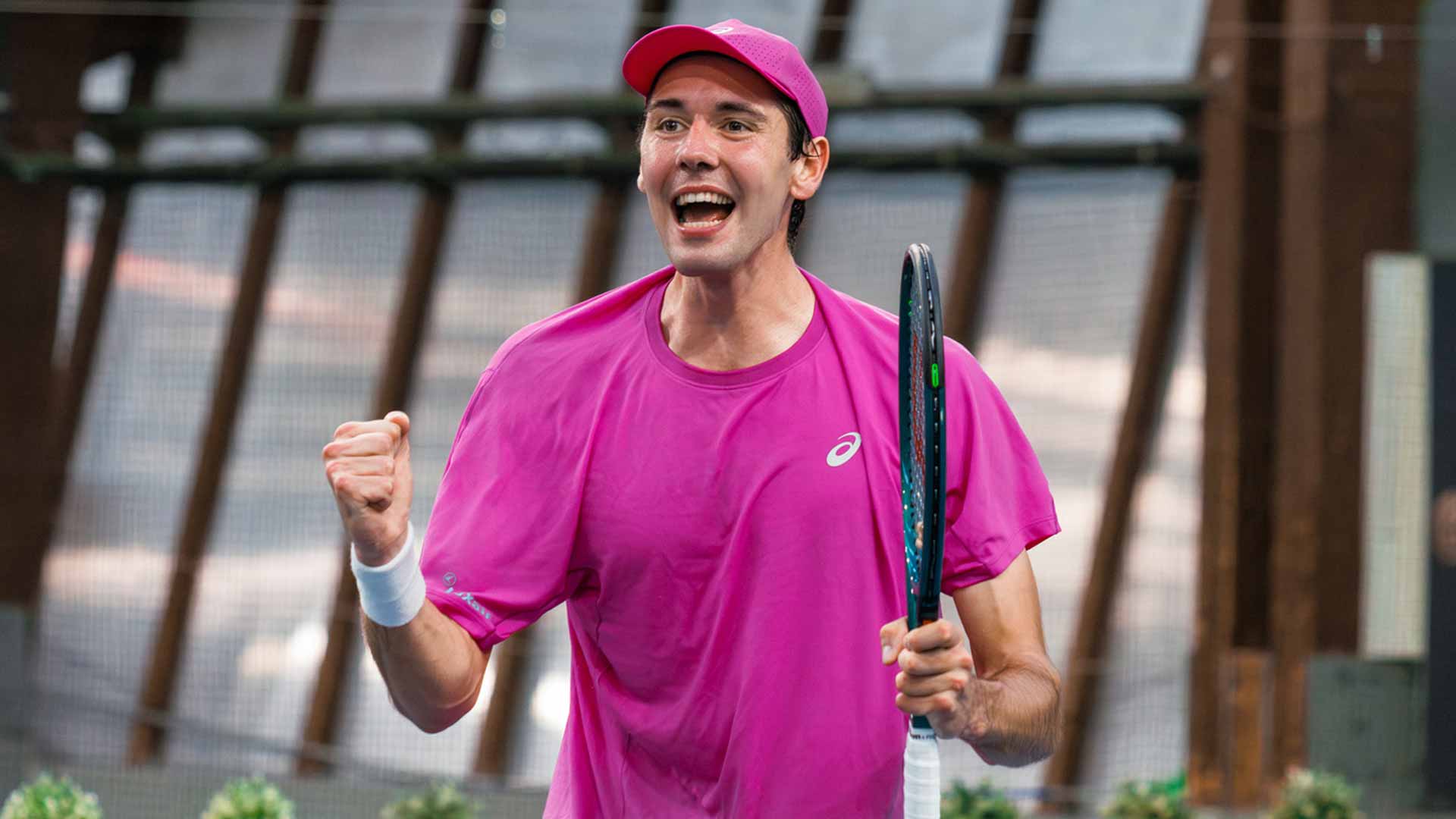
Chris Rodesch was a promising junior weighing a choice between college tennis and turning pro. At age 17, he appeared set on the collegiate path, until suddenly tennis entirely disappeared from the equation.
The Luxembourger was instead learning how to walk again and perform daily tasks in 2019. Rodesch — now at a career-high No. 138 in the PIF ATP Rankings following back-to-back title runs on the ATP Challenger circuit — was diagnosed with Guillain-Barré syndrome, an auto-immune disease triggered from food poisoning he contracted at a junior tournament.
“My body just went numb,” Rodesch told ATPTour.com. “I couldn’t open bottles anymore, I couldn’t walk straight anymore. I almost couldn’t walk stairs anymore because my nerves were not responding.”
Raised in a sporting household — his father a Luxembourg national footballer and his mother a former basketball player — Rodesch had spent his childhood building elite athletic skills. Rodesch, who stands tall at 6’6” (198cm), played handball and football, but tennis “was always number one”. He was inspired to pick up a racquet after watching Rafael Nadal and Roger Federer clash in a Roland Garros final.
But Rodesch’s lifelong athletic base quickly vanished when he battled the auto-immune disease.
“I remember going to the nerve doctor for the first time and I showed him what I couldn’t do anymore because of my nerves. I couldn’t stand straight anymore,” Rodesch recalled. “I lost my balance and right away he said, ‘This is it. This is the disease. We have to hospitalise you’.”
Rodesch’s health scare was so severe that, for a period, his tennis career became an afterthought.
“In the beginning, I was not even thinking about competitive tennis anymore,” Rodesch said. “I was just thinking of being healthy again, to be able to walk to school again because I was still in high school. Tennis really became the fifth option.”
Oeiras 1 🏆
— ATP Challenger (@ATPChallenger) February 1, 2026
Oeiras 2 🏆
What a fortnight of picking up prizes in Portugal for Rodesch#ATPChallenger pic.twitter.com/p4BysYUiCj
His path back to the court was a long journey, needing two years to return to the level at which he was previously playing. After three months of rehab, Rodesch began playing with a mini racquet and lightweight 10-and-under balls, aiming to rediscover the sensation of hitting a tennis ball. It took six months before Rodesch could play normally again and one year before he could start competing. It was a difficult, uncertain period.
“I saw all my friends playing these nice tournaments, the junior Grand Slams and I’m lying there in bed,” said Rodesch, who no longer lives with complications from the disease.
Even in the face of adversity, Rodesch recognised a bit of fortune. He also reflects on that frightening stretch with a sense of perspective.
“There’s people from that disease whose face gets deformed or who don’t recover from it, maybe in a wheelchair after,” he said. “It was a long process, but I had luck in the bad luck.
“I definitely learned to be patient, but also to find happiness in what we are doing here. We travel the world and we’re exploring these nice places.”
Before the illness, Rodesch was leaning towards playing college tennis in the United States and in 2020, that dream came true. He began his career at the University of Virginia, where he would become a three-time ITA All-American and graduate in 2024.
“I really give credit to the University of Virginia because I really had no results for two years with the sickness,” Rodesch said. “UVA is one of the most competitive college teams out there, so they definitely took a risk with me, giving me that scholarship, because I didn’t show them that I was ready to compete for them, I don’t think. I have to thank them so many times because they trusted me and it’s amazing from them and it shows their character.”
Following a standout career for the Cavaliers, Rodesch transitioned to the ATP Challenger circuit and has since claimed three titles at that level. His first triumph came last April in Tallahassee, where he ended Emilio Nava’s 19-match winning streak in the final.
“You always hear as a kid, ‘Challengers are kind of the stepping stone to the ATP’, and it just makes you proud to be part of this kind of history of the Challenger Tour,” Rodesch said of his maiden Challenger crown.
On Sunday, Rodesch capped a dominant two-week stretch at ATP Challenger events in Oeiras, Portugal, where he won two consecutive titles. He has plenty to be proud of, and a variety of lessons learned from overcoming Guillain-Barré syndrome.
“To be present in the moment when you achieve something big because it can go away quite fast with a thing like that,” Rodesch reflected. “I think all these little lessons I learned — being present, being patient, being positive — helps me even now sometimes going through a tough phase.”
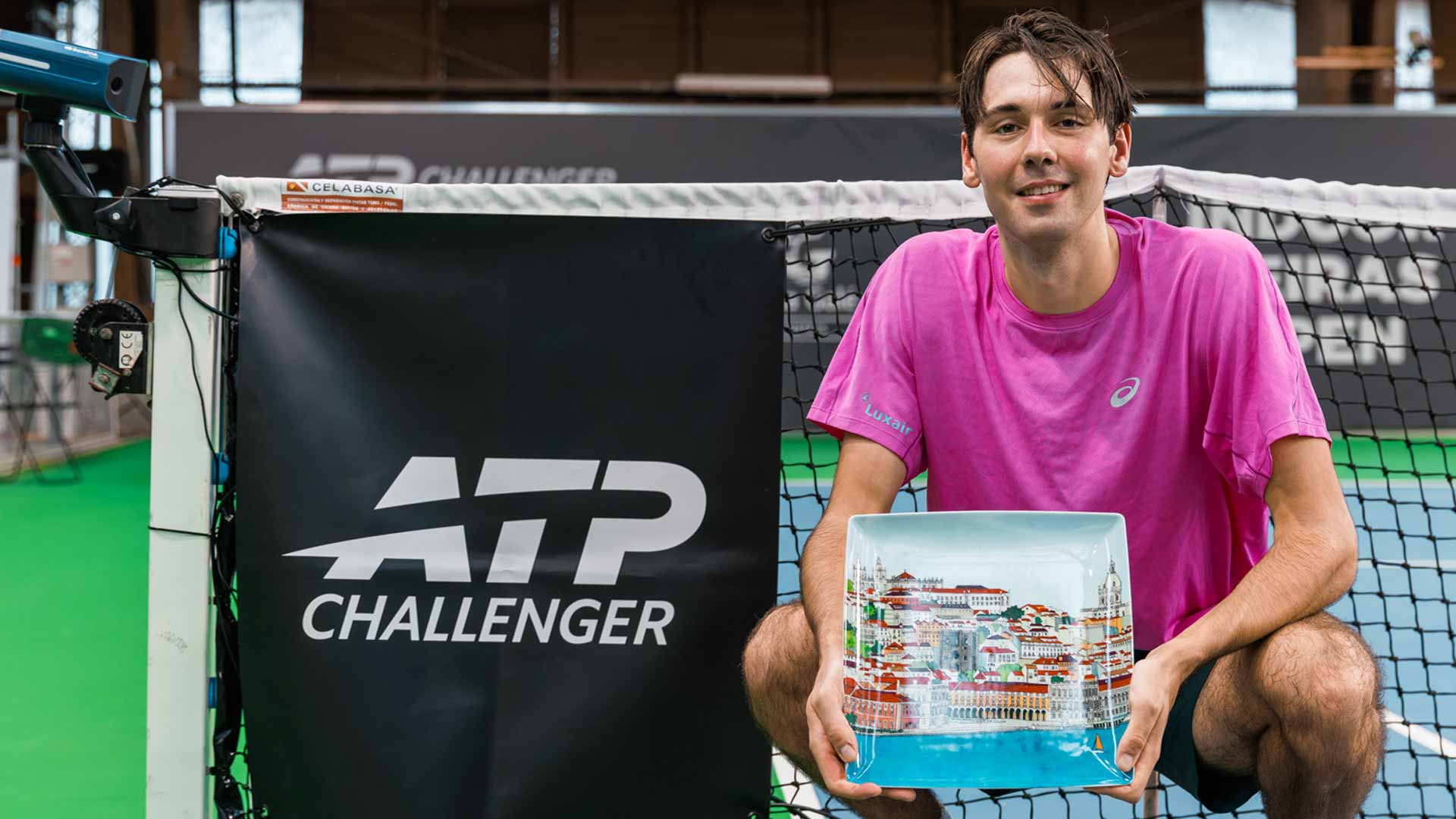
Chris Rodesch wins back-to-back ATP Challenger titles in Oeiras, Portugal. Credit: Beatriz Ruivo/FPT




© Copyright 1994 - 2026 ATP Tour, Inc. All Rights Reserved. No part of this site may be reproduced, stored in a retrieval system or transmitted in any way or by any means (including photocopying, recording or storing it in any medium by electronic means), without the written permission of ATP Tour, Inc.. Terms & Conditions | Privacy | Community Social Media Policy | Modern Slavery Statement | Feedback | Cookies | Your Privacy Choices 

