



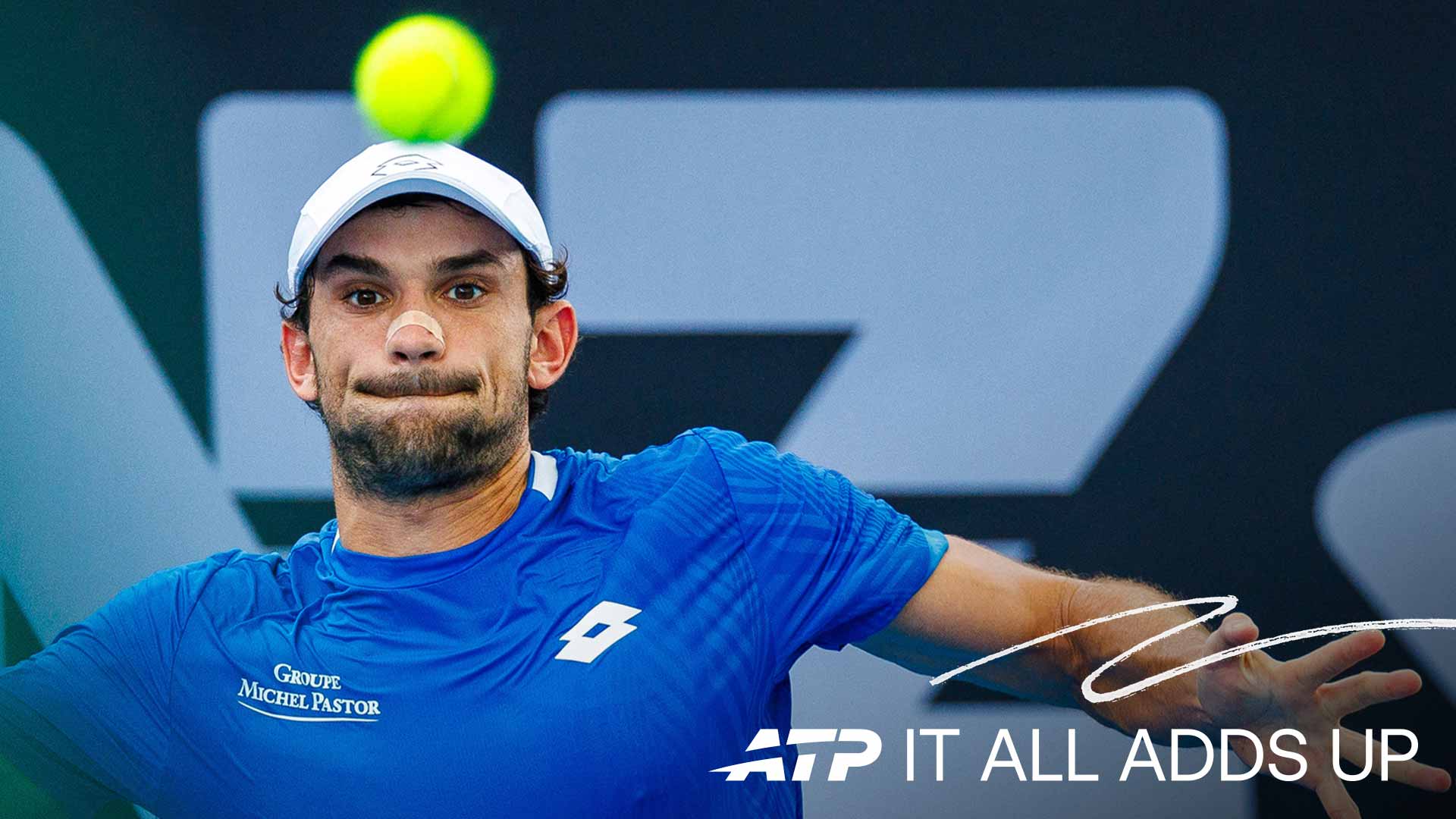
Can you have too much of a good thing? Valentin Vacherot isn’t too sure, particularly when it comes to discussing his stunning 2025 Rolex Shanghai Masters triumph.
The Monegasque became one of the fairy tale stories of last season after he came through qualifying to win the Chinese ATP Masters 1000 event, upsetting Novak Djokovic en route. For Vacherot, it was a breakthrough of such significance that he has no qualms reflecting on it three months on, even with the knowledge that pro tennis is a fast-paced world in which such highs can quickly be replaced by lows.
“Of course I want to focus on what is coming ahead, but I’m not going to be mad about talking about Shanghai,” the lowest-ranked Masters 1000 champion in history told ATPTour.com ahead of his main-draw debut at the Australian Open. “It’s just amazing what happened and of course I’m happy to talk about it.
“Immediately after it was not easy because the season wasn’t over and I got wild cards in Basel and in Paris. When you’re in a tournament, and everyone keeps talking about the previous tournament, that’s when it’s not easy. What is good is that I played good as well in those tournaments, so it helped put a little bit of a stop on Shanghai and let me straightaway focus on the current one.”
Even in the offseason, Vacherot continued to feel the effects of his exploits in China. Before 2025, the Monegasque was accustomed to competing at ATP Challengers through late November or early December before closing each season. Yet by winning Shanghai and later reaching the quarter-finals at the Rolex Paris Masters to hit a career-high No. 30 in the PIF ATP Rankings, Vacherot was able to enjoy a different end to his year.
“The big difference is that by having played so well and on the big Tour for the past months, I finished my season on the second of November,” said the 27-year-old, who won Breakthrough of the Year in the 2025 ATP Awards. “That meant two weeks of vacation, and I went back to training on the 15th of November. So I had seven weeks of training, and I’ve never had that before.
“That was amazing to get ready for the big stage. Also with all that happened, let’s say that it was a bit easier to go every day, every morning, for practice. I did six weeks at home and then I left early to come to Australia to do the last eight or nine days of training. But of course, it was motivating to wake up after all I’d done.”
Vacherot certainly put in plenty of groundwork to secure the right to play his first full season on the ATP Tour, having racked up a 64-45 record at ATP Challengers across his career (including four titles) according to the Infosys ATP Win/Loss Index. He sees the scheduling benefits from now being at tennis’ top table continuing into his 2026 season.
“Sometimes with Challengers, it is ‘How many weeks do I play?’ Because if you want to play Challengers every week you can, but it’s not great,” explained Vacherot, who began 2026 with a first-round exit in Brisbane and a quarter-final run in Adelaide. “Now it’s more like, ‘Okay, there are those tournaments to play’. Sometimes you pick, in between those weeks, between two ATP 250s, and that’s it. Because you aren’t going to skip any 500s or 1000s, you know exactly what you’re going to play. It’s wonderful.
“Now it’s going to be more about, ‘Which weeks do I take off?’ When I start playing well, I can take weeks off to get fresh again. I think it’s important on the big Tour to be fresh physically and mentally when you step on court because everyone is so good. You need to be almost 100 per cent every time.”
Vacherot’s only previous main-draw appearance at a Grand Slam came as a qualifier at 2024 Roland Garros. On Monday night at the Australian Open, he will bid to notch his first victory at a major when he faces qualifier Martin Damm at Melbourne Park. It would be the latest milestone in a career that has moved so fast in such little time that Vacherot and his team, led by his coach and half-brother Benjamin Ballaret, have had to recalibrate their expectations.
“We had to [set new goals], because two months before the end of the season, I wasn’t expecting to finish No. 31 in the world and to be playing a schedule full of ATPs,” said Vacherot. “It’s easy to say we aren’t putting a goal on my ranking, but it’s more about basically what I did at the end of last season. Weeks when I feel like I have my chance, where I start playing good at the beginning of the tournament, and use those first matches to not just stop at the first or second round. Try to go straightaway to semi-finals or finals.
“That’s how it works if you want to rack up points, you have to go deep at tournaments. I know I’m not going to make quarter-finals or semi-finals every week, because everyone plays so well… But use the weeks where you feel good, where you play good and really try to make as much of it as possible. Of course, I also had to put in a goal for Grand Slams. If I can catch a second week, even in Melbourne, that would be great and allow me to put in some other goals.”




© Copyright 1994 - 2026 ATP Tour, Inc. All Rights Reserved. No part of this site may be reproduced, stored in a retrieval system or transmitted in any way or by any means (including photocopying, recording or storing it in any medium by electronic means), without the written permission of ATP Tour, Inc.. Terms & Conditions | Privacy | Community Social Media Policy | Modern Slavery Statement | Feedback | Cookies | Your Privacy Choices 


