



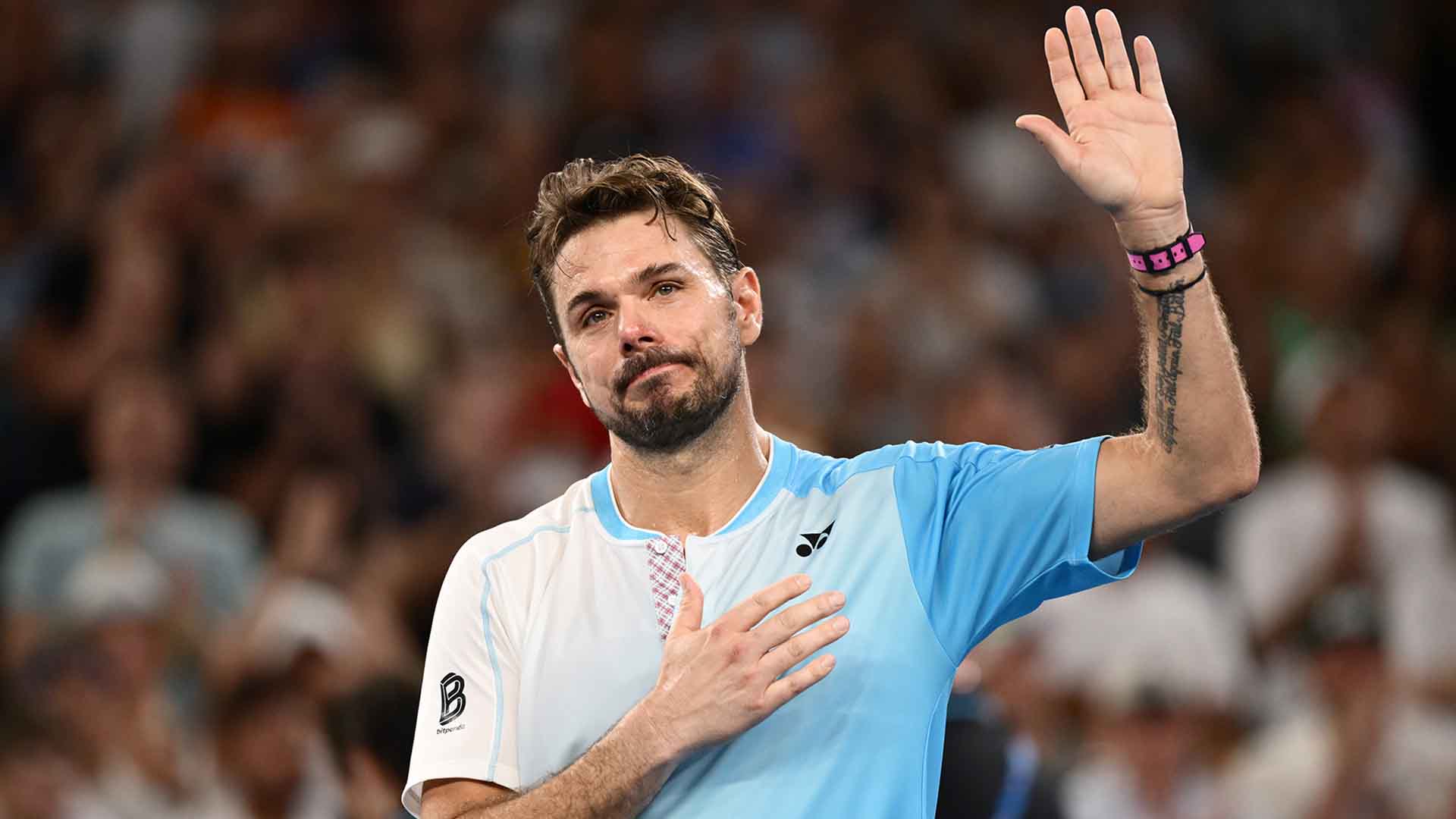
Stan Wawrinka will be remembered for his stylish one-handed backhand, unwavering determination and humility, qualities that made him one of the most distinctive players of his generation.
The 41-year-old Swiss, who brought his ATP Tour career to an end on Tuesday at the Swiss Indoors Basel, won three major titles, notched 59 tour-level victories and reached No. 3 in the PIF ATP Rankings. For Wawrinka, however, legacy has never been about how others remember him, but about the effort he put into every match and the respect he showed everyone around him.
“It’s not up to me. There are different visions of me as a player over the past 20 years,” Wawrinka told ATPTour.com when asked about his legacy. “For me, all I wanted in my career was to give everything, to have no regrets, to always fight, to always give 100 per cent in every match — out of respect for myself, for the opponent, for the tournament, for the fans, for everybody.
“That was always the most important thing for more than 20 years, and that’s the only way you can leave the sport: without any regrets.”
Wawrinka has little to regret after repeatedly defying expectations, none more memorably than at the 2016 US Open, where, aged 31, he faced the pressure of what could have been his last realistic chance to win another major title. He turned to longtime coach Magnus Norman for advice before defeating Novak Djokovic in four sets to become the oldest men’s singles champion in New York in the Open Era at the time.
It marked Wawrinka's third and final major title, with each of those Grand Slam final victories having come against a World No. 1.
“It was a stressful moment — that can happen in sport,” Wawrinka said. “I was really nervous coming into the final. It was not the easiest entry ever, but I had a great talk with Magnus, who really helped me to get through that moment. He really helped me to be in the moment and to not think too much about the outcome."
Norman, who witnessed Wawrinka’s dedication throughout their partnership and right into his final season in 2026, has also seen the impact of a character that extends well beyond the baseline. For all the power of his backhand, the Swiss has always been admired for treating everyone around him with the same warmth and respect.
“He’s just someone you want to go out and have a beer with, which I think is why he’s so liked throughout the world,” Norman told ATPTour.com. “Speaking to all his colleagues on the Tour, no one has anything bad to say about Stan. He treats everyone the same, whether it’s the driver, the cleaning lady at the hotel, the ball boys and ball girls, or the number one player in the world. For Stan, it really doesn’t matter. He treats everyone the same, and that’s what I’m taking with me.”
Most Tour-Level Wins After Turning 40 (since ATP Tour was established in 1990)
| Player | Wins | Achieved In |
| Stan Wawrinka | 12 | 2025-26 |
| Ivo Karlovic | 9 | 2019-21 |
| Jimmy Connors | 8 | 1992-95 |
That generosity has extended to fellow players such as Matteo Berrettini, whom Wawrinka faced in the first round of Wimbledon and the US Open this year, but whose relationship with the Swiss goes beyond their matches. When they spoke in Monte-Carlo earlier in the season, Wawrinka offered the Italian encouragement at a time when injuries and inconsistent form had tested his belief.
The former World No. 6 and Wimbledon finalist took heart from Wawrinka’s experience, finding inspiration in a player who continued to compete against younger opponents into his forties.
“He was always so supportive of me,” Berrettini said. “Every time we were talking, he was giving me great knowledge about the sport, and especially about loving the game. You could tell how much he loved the game and how much he loves to compete.
“I was talking to him, and he told me that his best year was when he was 30. He actually told me that at the Monte-Carlo tournament this year. It also gave me that feeling that I’m not old, that I can still play and get good results.”
Wawrinka’s influence is also written into the shot that defined his career: the one-handed backhand. It is a powerful and elegant weapon that helped deliver 16 tour-level titles and countless spectacular winners. Even in his final seasons, it continued to fire, reminding fans why few players could match the Swiss when he had time to unleash it.
As the one-handed backhand becomes an increasingly rare sight at the highest level, Wawrinka has helped preserve its appeal alongside fellow Swiss great Roger Federer, inspiring players such as Lorenzo Musetti.
“He was my first opponent when I got my first win on the ATP Tour in Rome in 2020,” Musetti reflected. “For me, it was such a beautiful beginning to my career facing an opponent like him, I grew up idolising him. He was one of the kings of the one-handed backhand. For me, it was a special moment to face him, and beating him was even more important."
Wawrinka’s legacy will also live on through the young Swiss players he has helped, with the three-time major champion always willing to share his experience and offer advice to those following in his footsteps. Among them is 19-year-old Henry Bernet, whose one-handed backhand is reminiscent of Wawrinka’s.
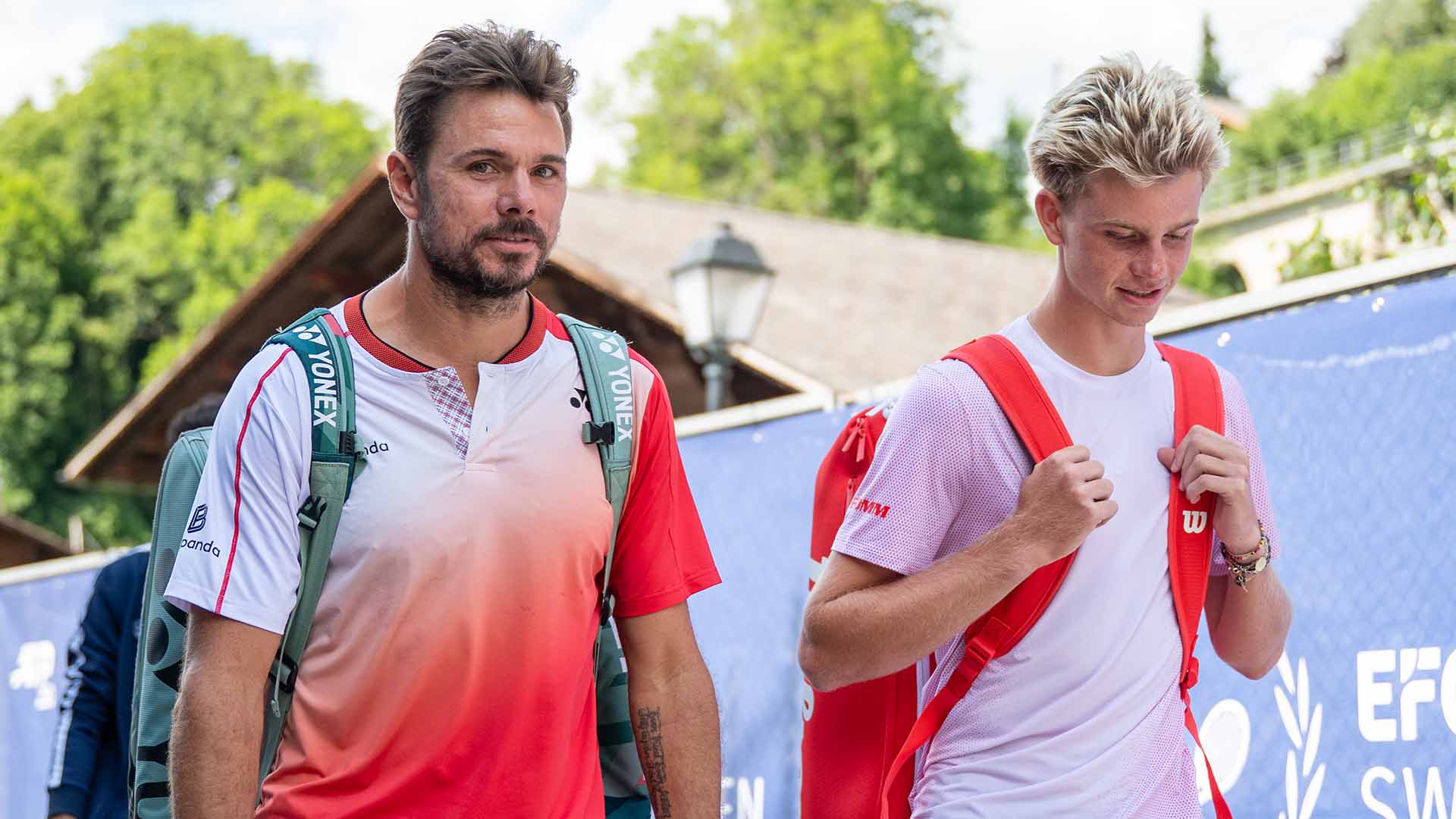 Stan Wawrinka and Henry Bernet play doubles in Gstaad in 2025. Photo: EFG Swiss Open Gstaad.
The #NextGenATP teen has practised alongside Wawrinka many times and the pair even shared the double’s court in Gstaad last year. Bernet, the 2025 Australian Open boys’ singles champion, knows how valuable it is to learn from a player who has achieved so much while remaining eager to help the next generation.
“Stan had an unbelievable career,” Bernet said. “If we look back now, having a [Swiss] tennis player with three Grand Slam titles and being Top 100 all of the time, we would be really happy. Every time I was practising with him, it was really a really important experience, and I feel like he's really wanting to help us younger players to make the step to the big Tour.”
As Wawrinka leaves the sport, his backhand and three major titles will endure in the highlights, but so too will his fighting spirit, humility and generosity towards those around him. For a player who gave everything to tennis, perhaps his greatest legacy will be the inspiration he leaves behind.



© Copyright 1994 - 2026 ATP Tour, Inc. All Rights Reserved. No part of this site may be reproduced, stored in a retrieval system or transmitted in any way or by any means (including photocopying, recording or storing it in any medium by electronic means), without the written permission of ATP Tour, Inc.. Terms & Conditions | Privacy | Community Social Media Policy | Modern Slavery Statement | Feedback | Cookies | Your Privacy Choices 

