




Yevgeny Kafelnikov could not help but ponder how quickly time has passed. “I don’t even want to think about it,” the ATP No. 1 Club member said.
But 30 years ago, Kafelnikov accomplished something at Roland Garros that a man has not done at any Grand Slam event since. At 22 years old, the righty won both the singles and doubles titles at the clay-court major.
“I had a plan. I had a task in my hands, which I needed to do,” Kafelnikov told ATPTour.com. “My form at the time was so fantastic, and the self belief was beyond anything I felt in my career. It was almost destined that I was going to win.
“[It was] not 100 per cent, but I felt like I had a pretty good chance, given the way my form was before the tournament.”
In tennis today, it is rare to see a doubles standout compete deep into a singles draw at Grand Slam tournaments. No major men’s doubles champion has also claimed singles Slam glory in his career since 2002 when, fittingly, Kafelnikov emerged victorious at Roland Garros with Paul Haarhuis. But no man has won both at the same tournament in 30 years, and Kafelnikov did so convincingly.
Earlier that 1996 clay season, the rising star had won an ATP Tour title in Prague, made an ATP Masters 1000 semi-final in Hamburg and, importantly for his confidence, cruised past fellow ATP No. 1 Club member Pete Sampras 6-3, 6-2 at the World Team Cup in Dusseldorf. While clay was never Sampras’ best surface, the No. 1 player in the PIF ATP Rankings had won his first four Lexus ATP Head2Head meetings against Kafelnikov.
“I think Pete didn't even believe that I played clay so well in that particular time because [of what] my record before those two matches was [against him],” Kafelnikov said. “And even on the clay, he beat me. Last time we played, it was in the final of Davis Cup, and most of them we played three straight sets. So he didn't feel like he was going to lose the match against me.
“But on a different court, I showed them that it was a different story five months later, from December to May. And I think that's what got him in the semi-finals of Roland Garros, too.”

Semi-final adversary Sampras was the most famous of Kafelnikov’s opponents at Roland Garros that year, and the lone Top-10 opponent he faced. But the two-time major singles champion (1999 Australian Open) pointed out that he faced a tricky draw, with three Spanish opponents who excelled on clay in his first four matches: Galo Blanco, Felix Mantilla and Francisco Clavet.
“It's not easy to get those guys on the clay, and I thumped them. All of them,” Kafelnikov said. “That was because of self belief.”
The year before, Kafelnikov had lost in the semi-finals at Roland Garros to eventual champion Thomas Muster. But with four consecutive straight-sets victories to begin his tournament, the stage was set for another deep run. It was at that moment of the tournament when Kafelnikov was even happier with something that happened elsewhere in the draw: Michael Stich upset second-seeded Muster.
“I was physically strong. I was physically ready to compete for three, four, five hours against anybody at the time. Except maybe Muster,” Kafelnikov said. “That's actually one player I really wanted to avoid in the draw. Luckily, Michael beat him in the fourth round. That was probably one player I felt like I could have had problems with.
“The whole package of Thomas on the clay court was sensational. He was doing all sorts of records… In 1995 and 1996, he was unstoppable. And the previous year, he beat me in three straight sets in the semi-final, so that kind of was in the back of my head. Again, the only player that could give me really, really big problems was him. Only him, nobody else.”
At the same time, Kafelnikov was not concerned about the physical toll advancing through the singles and doubles draws would take. After four of his singles victories, he went on eight-kilometre runs around Court Philippe-Chatrier.
“I believed that all the dedication, all the hard work, was going to pay [off],” Kafelnikov said. “The time I've spent on the court and off the court and in the gym, I was going to get rewarded. That was important.”
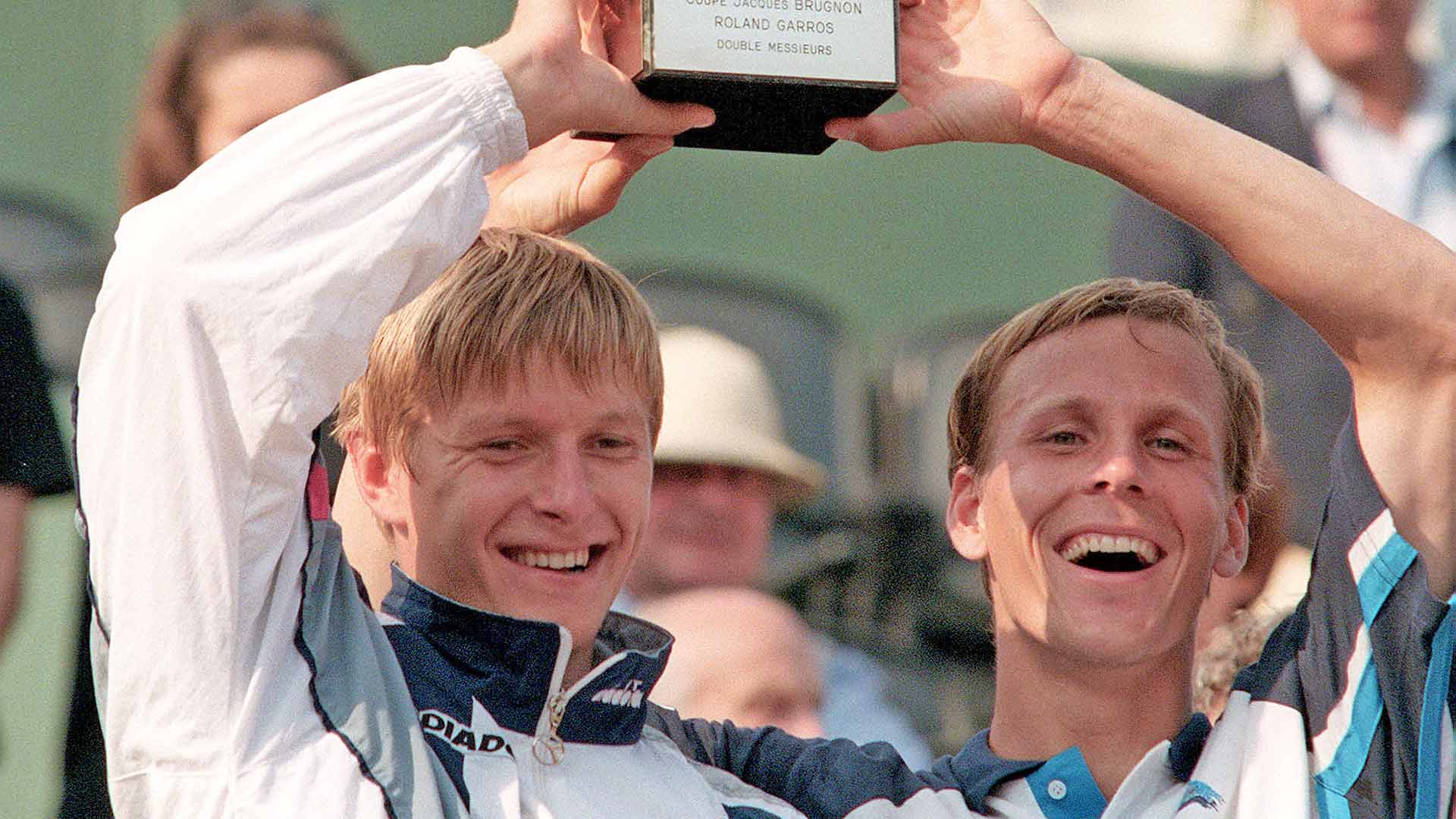
Yevgeny Kafelnikov and Daniel Vacek celebrate their 1996 Roland Garros doubles title. Photo Credit: AFP/Getty Images
Kafelnikov and Daniel Vacek cruised through the doubles field without losing a set. And in singles, the champion only dropped a set to Richard Krajicek in the quarter-finals. After ousting Sampras 7-6(4), 6-0, 6-2 in the semi-finals, he beat Stich 7-6(4), 7-5, 7-6(4) for the trophy.
Just less than three years later, Kafelnikov reached the No. 1 spot in the PIF ATP Rankings.
Three decades on, there is a lot of respect in the tennis world for his effort in Paris. Alexander Zverev, who is pursuing his first major title at Roland Garros this year, had high praise for Kafelnikov’s singles-doubles sweep.
“That’s impossible [today]. That’s why I said he is the most underrated player of all time. He was probably not as exciting as [Andre] Agassi, or Pete Sampras or Marat Safin. But he was winning,” Zverev told ATPTour.com. “He has won way more than Marat Safin, and people know Marat Safin way more than they know him because he was always kind of under the radar, a quiet guy who didn’t need attention. But he was an absolute monster.”
About Kafelnikov’s game, Zverev added: “To beat him, you had to play really, really well. He wouldn’t let you win by himself… Thirty years ago, there wasn’t maybe as much power as there is now. You could hit people off the court, and I think that's what made him great.”
It is that tennis with which Kafelnikov remains in the history books. The ATP No. 1 Club member summed it up succinctly.
“Nobody will ever repeat it in my lifetime.”
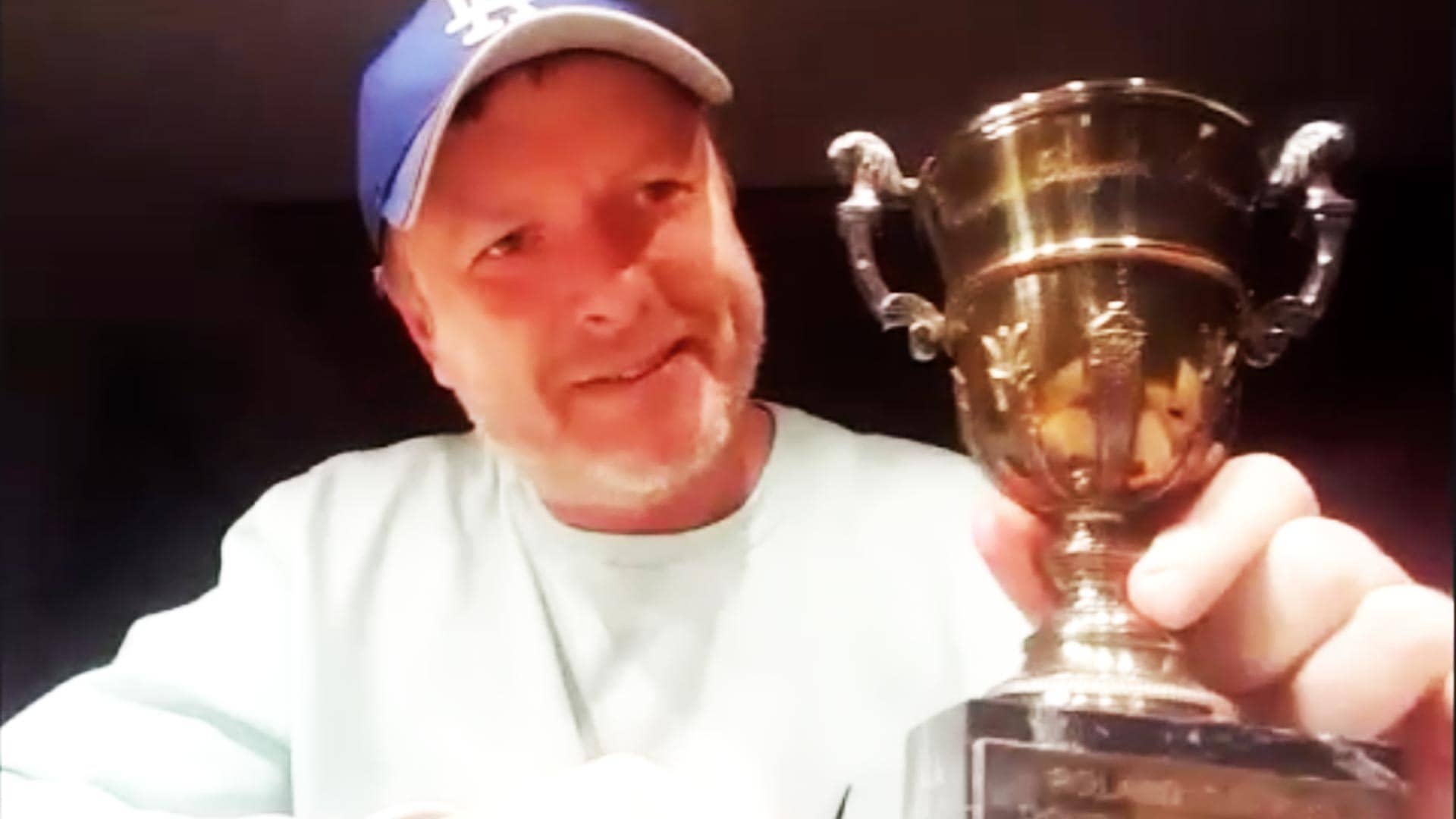
Kafelnikov with his Roland Garros trophy in 2020.



© Copyright 1994 - 2026 ATP Tour, Inc. All Rights Reserved. No part of this site may be reproduced, stored in a retrieval system or transmitted in any way or by any means (including photocopying, recording or storing it in any medium by electronic means), without the written permission of ATP Tour, Inc.. Terms & Conditions | Privacy | Community Social Media Policy | Modern Slavery Statement | Feedback | Cookies | Your Privacy Choices 

