



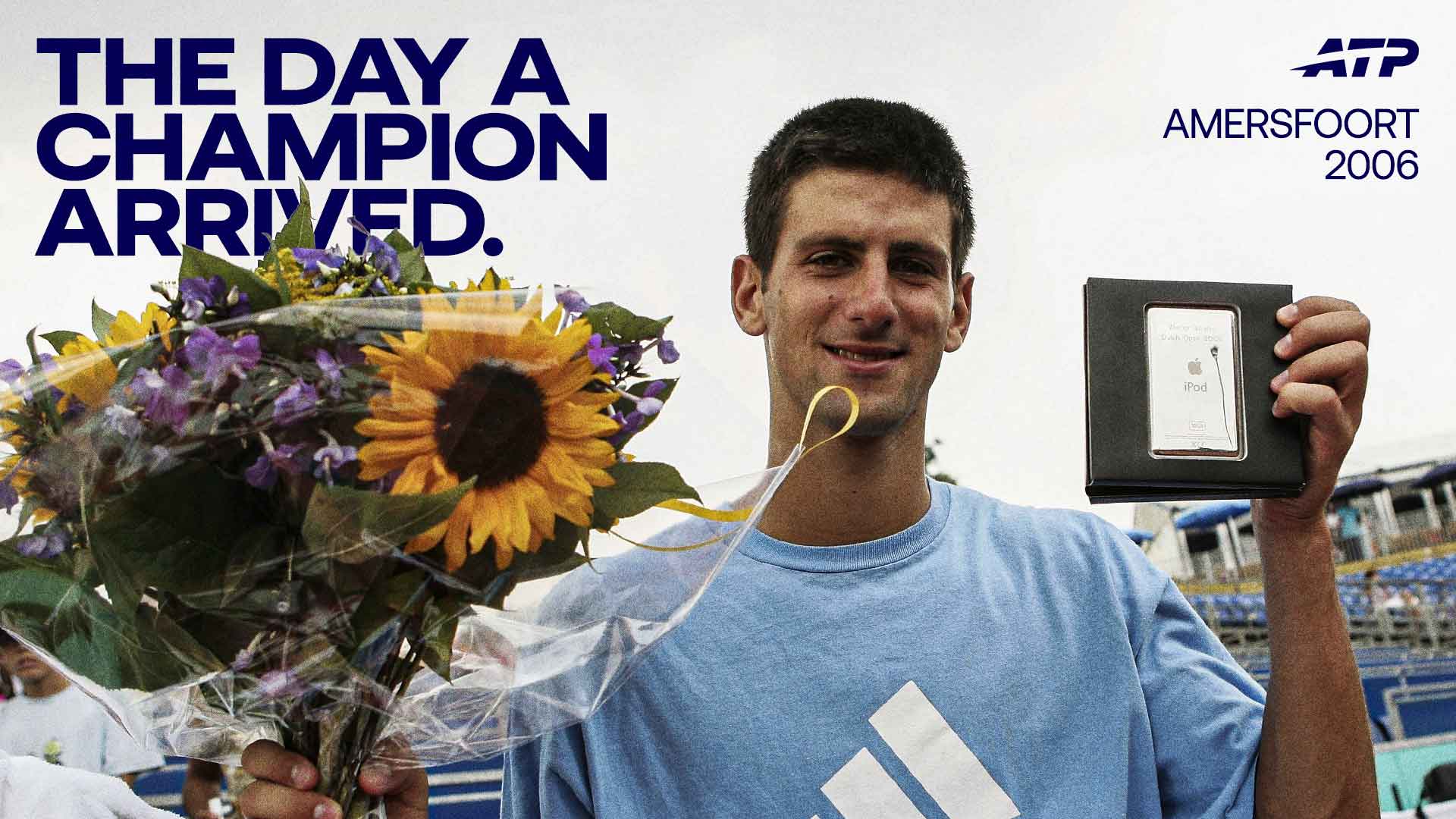
23 July 2006. A future champion claimed his first crown.
Novak Djokovic was just 19 years old but was already beginning to show glimpses of the talent that would eventually take him to the summit of men’s tennis. Earlier in 2006, the Serbian had broken into the Top 50 and reached the Roland Garros quarter-finals, establishing himself as one of the game’s brightest young stars.
However, he had yet to check off one big milestone: A tour-level title.
That changed in July 2006 at the ATP Tour event in Amersfoort, Netherlands. Arriving on the red clay in confident form, Djokovic had reached the fourth round at Wimbledon just weeks earlier and entered the event seeded third and at No. 36 in the PIF ATP Rankings.
The teenager was climbing quickly, but he had never reached a tour-level final, let alone lifted a trophy. In Amersfoort, that changed in emphatic fashion. Djokovic did not drop a set through his opening three matches, dispatching Boris Pashanski, Tomas Zib and Marc Gicquel to transition seamlessly from Wimbledon’s grass courts to the Dutch clay.
The Serbian’s first significant test came in the semi-finals against top seed Guillermo Coria, an eight-time tour-level champion on clay and one of the sport’s most accomplished players on the surface. Djokovic raced to a 6-2, 1-0 lead before Coria retired, sending the 19-year-old into his first ATP Tour final.
Standing in his way was Nicolas Massu. The Chilean, seeded fourth, was a proven clay-court winner. He had triumphed in Amersfoort in 2003 and arrived in the championship match having already reached three finals on clay that season. But Djokovic showed no signs of being overawed by the occasion.
In a tense championship match, the Serbian faced adversity early. Djokovic failed to convert two set points on Massu’s serve at 5-6 in the opening set and then fell behind 0/3 in the tie-break. But Djokovic responded with the composure that would become a defining characteristic of his career, winning seven of the next nine points to take control.
After breaking early in the second set, Djokovic held his nerve to close out a 7-6(5), 6-4 victory on his second championship point when Massu sent a forehand long.
“I remember that it was a really close match,” Massu previously told ATPTour.com. “I had chances in the first set. I led 3/0 in the first-set tie-break and he was showing a lot of personality at that time. He was showing unbelievable talent, fighting spirit, also entertainment, because he was a very complete player. He had a lot of courage in important moments for that age.”
Massu had enjoyed one of his best seasons on clay in 2006, reaching four finals and winning one title, but he was struck by Djokovic’s mentality.
“That year I was playing really good on clay. I was one of the guys who won more on clay that year and I played four finals. I won one, so I was playing well. The match was close, but what surprised me at that age was the courage he had at 19 years old to show resolve and to have solutions in the important moments, besides all the tennis parts, [although] they were amazing also,” Massu said.
The victory propelled Djokovic into the Top 30 of the PIF ATP Rankings for the first time, rising from No. 36 to No. 28. He has not fallen outside that group since.
The breakthrough also came less than two years after Djokovic made his tour-level debut in Bucharest in September 2004. Three months after his Amersfoort triumph, he added a second title in Metz.
Djokovic’s first ATP Masters 1000 crown followed in Miami in 2007, before he captured his maiden major title at the Australian Open in 2008. Now a 101-time tour-level champion, Djokovic has rewritten the history books with a record 24 Grand Slam titles and 40 ATP Masters 1000 crowns.
But every journey has a starting point. For Djokovic, it began on the clay of Amersfoort, with a first trophy, a first taste of championship success and the opening chapter of a historic career.




© Copyright 1994 - 2026 ATP Tour, Inc. All Rights Reserved. No part of this site may be reproduced, stored in a retrieval system or transmitted in any way or by any means (including photocopying, recording or storing it in any medium by electronic means), without the written permission of ATP Tour, Inc.. Terms & Conditions | Privacy | Community Social Media Policy | Modern Slavery Statement | Feedback | Cookies | Your Privacy Choices 

