



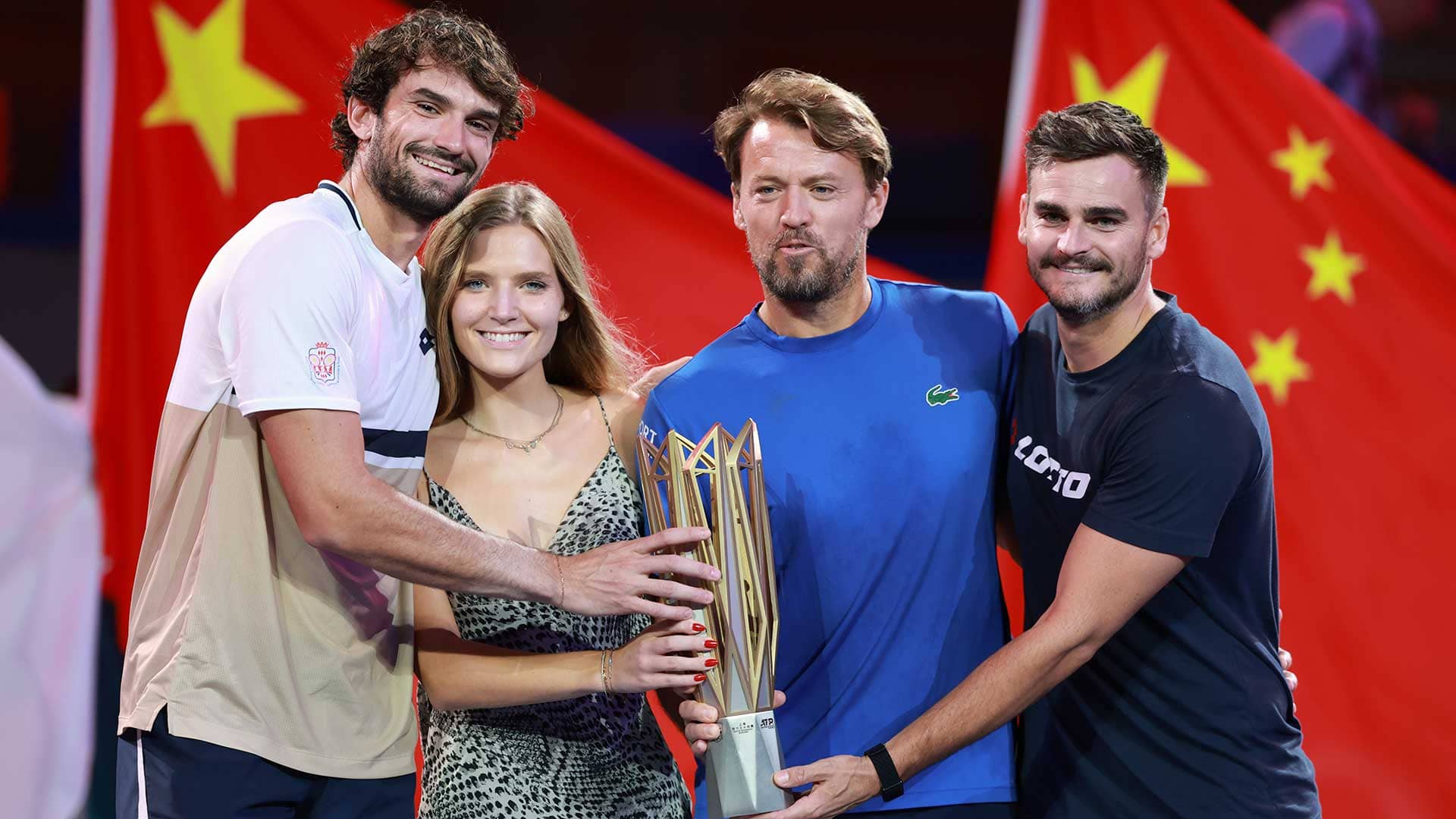
A year ago, Valentin Vacherot arrived at the Rolex Shanghai Masters at No. 204 in the PIF ATP Rankings, with just one tour-level victory to his name.
The Monegasque star came within two points of losing in qualifying at the hard-court event, but survived to reach the main draw and then kept winning. Laslo Djere, Alexander Bublik, Tomas Machac, Tallon Griekspoor and Holger Rune all lost to Vacherot, who then battled past Novak Djokovic and his cousin Arthur Rinderknech to complete one of the most remarkable runs in ATP Masters 1000 history.
By the end of the fortnight, Vacherot had won seven main-draw matches to become a Masters 1000 champion, while the 27-year-old was the lowest-ranked player to win a title at that level and also the first player representing Monaco to win a tour-level crown in the Open Era (since 1968).
Twelve months later, Vacherot returns to the scene of his greatest triumph at a career-high No. 14, ready to begin his title defence against Sebastian Baez. Ahead of his return to Shanghai, Vacherot and coach Benjamin Balleret looked back on the tournament that changed his career, starting with his stunning semi-final victory against Djokovic.
“I always said it's weird because the Djokovic match is the only match where almost everything went right. It was not three sets. I was not behind or saving break points,” Vacherot remembers fondly.
Vacherot earned a 6-3, 6-4 win against Djokovic to record his second Top-10 victory of the week, having also beaten Rune. The Serbian struggled physically for large periods of the Lexus ATP Head2Head meeting, but Balleret knew the 102-time tour-level titlist would not go away easily.
“The thing is difficult. When you win the first set [it looked like] Novak was going to retire, but you know he will not because it's Novak and he's fighting. But you never know how to feel in this match,” Balleret said.

Vacherot was mindful of Djokovic's condition and tried to handle the moment respectfully. After the match, the Serbian offered words of encouragement that left a lasting impression.
“He saw that I was really respectful because I saw that he was struggling physically the whole match. I wasn't going to drop on the ground for the celebration. And I just let him speak, and he said that I totally deserved the win and not to think about anything other than the win. He was being super nice,” Vacherot said.
The victory earned Vacherot a place in his first Masters 1000 final. Waiting on the other side of the net was his cousin, World No. 54 Rinderknech, whose own remarkable run – including wins against Alexander Zverev and Daniil Medvedev – had set up a meeting neither man could have imagined when they arrived in Shanghai two weeks earlier.
The cousins had competed together at Texas A&M University in 2018, but their connection stretched back much further, to childhood games in the garden at Vacherot's family home.
“I think with Arthur, we didn't play tennis until I got to Texas A&M,” Vacherot said. “We didn't play tennis that much together because we were always on vacation. But Arthur reminded me, I was probably eight years old, and he was 11 years old, how we used to play, acting like we were in the Wimbledon final in the garden at my parents’ house.”

Years later, those childhood games had given way to a real Masters 1000 championship match. Yet even with a title at stake, their familiarity remained. The pair warmed up together before the final, a decision that felt entirely natural to Vacherot.
“Arthur asked me, ‘Did you want to hit together?’ And I said, ‘Of course,’” Vacherot said.
“I think it would have been weirder if you didn't warm up together,” Balleret added. “On the same court, there would be two hitting partners, so it would have been weird. Anyway, you know each other by heart and especially after seven matches, you're not going to do a big warm-up.”
That ease off court contrasted with what they were about to play for. Vacherot entered the tournament as a qualifier ranked outside the Top 200, making the prospect of a Masters 1000 final almost impossible to comprehend. Vacherot felt Rinderknech, an established tour-level player, had a different relationship with the opportunity.
“It was more of a dream for me. Arthur, in my opinion, he deserved it as well, given how he was going to be in a big final. It was less of a dream for him, like that it could have happened for him,” Vacherot said.
“I think Arthur was more under pressure. Because it was more unexpected for me than for him. Him making a Masters 1000 final could happen for him at any Masters 1000. But me, I was No. 200. If I’d lost, I would have been so happy for him. Of course, he was so happy for me, but I feel like he had more to lose than I did.”
Vacherot went on to win the final 4-6, 6-3, 6-3, becoming just the third qualifier to win a Masters 1000 title, joining Roberto Carretero (Hamburg, 1996), and Albert Portas (Hamburg, 2001).
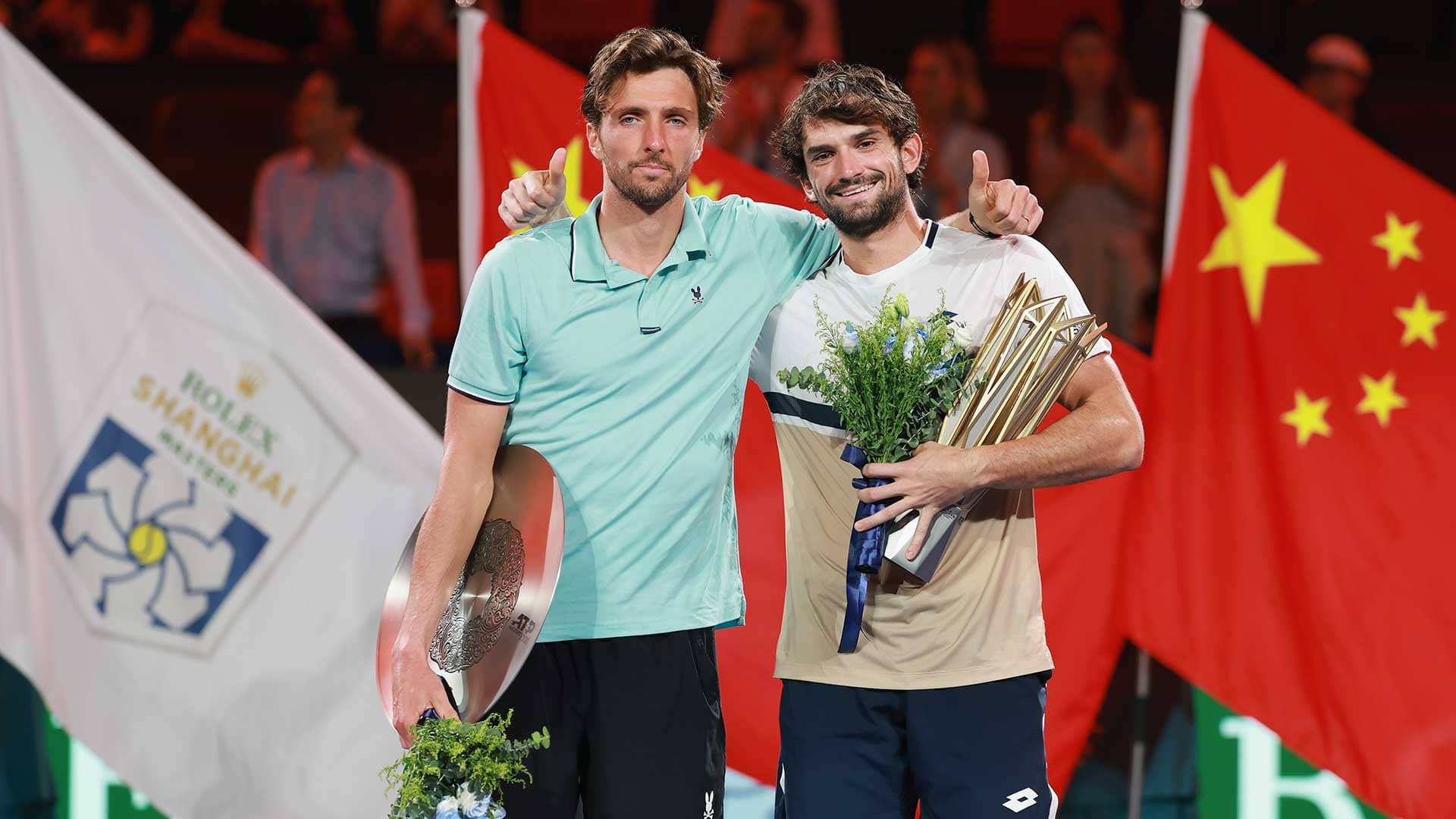
Photo Credit: Getty Images
The achievement was extraordinary, but Vacherot’s close bond with Rinderknech made the final more complicated than a typical title-winning moment.
“If I played any other player, I would have been on the ground after winning,” Vacherot said when looking back at his winning moment.
That mixture of happiness and consideration carried into the trophy ceremony. As Vacherot reflected on the journey they had shared, Rinderknech helped ease the tension of a moment neither would forget.
“We had really nice words for each other. I owe him some parts of my tennis career,” Vacherot said. “I was a bit tense during the whole speech. And he kind of relaxed me. I dreamed of winning, but nothing I expected at the start of the tournament. Sometimes people say, I trained my speech in the shower when I was a kid, I never did that. I think I did a good job.”
Away from the pressure of each match, Vacherot also had a close-knit support group helping him through the tournament. Alongside Balleret, his girlfriend, Emily Snyder, was part of a small circle that included Rinderknech himself, until the cousins met in the final.
“We had like this kind of little bubble where it was just you [Balleret], me, Emily and Arthur as well, because we spent generally two weeks together,” Vacherot said. "If we didn't have matches or training, we were going to dinner. And my girlfriend, to be honest, she was not even supposed to come. But we decided she could come because I was going to play so many tournaments after, and I wasn't going to be home for so long.”
That support helped make an extraordinary fortnight feel more familiar. Vacherot rose 164 spots to No. 40 following his Shanghai run, opening the door to direct entry into ATP Tour main draws and helping pave the way for his first full season competing regularly at the highest level. In 2026, Vacherot has continued to build on that breakthrough, reaching the semi-finals on home soil at the Rolex Monte-Carlo Masters in April before making another semi-final in Tokyo last week.
Now back in Shanghai, can Vacherot achieve more history and become just the third player to successfully defend his title at the Masters 1000 event?




© Copyright 1994 - 2026 ATP Tour, Inc. All Rights Reserved. No part of this site may be reproduced, stored in a retrieval system or transmitted in any way or by any means (including photocopying, recording or storing it in any medium by electronic means), without the written permission of ATP Tour, Inc.. Terms & Conditions | Privacy | Community Social Media Policy | Modern Slavery Statement | Feedback | Cookies | Your Privacy Choices 

